Transferable Skills 2026 What Employers Look For and How to Develop Them

Introduction: Why Transferable Skills Are the Currency of the Modern Workplace
The workplace looks nothing like it did five years ago. Jobs change fast. New technology appears overnight. And the roles that existed last year might not exist next year. So what keeps you valuable through all that change? Your transferable skills.
These are the abilities you carry with you from one job to the next. Things like communication, leadership, problem solving, and adaptability. Research shows that in 2026, employers care more about these general skills than ever before.
They want people who can think, collaborate, and lead no matter what industry they work in.
But here is the challenge. Most teams have no real plan to find, grow, or use these skills. Transferable skills like teamwork and analytical thinking often get overlooked because they do not show up on a resume as clearly as technical abilities do. And while many organizations push for better communication and stronger team dynamics, they skip the step of actually building those skills on purpose.
That is where this article comes in. We will walk through research backed insights and simple frameworks you can use to identify and develop transferable skills inside your team. You will learn how to spot hidden strengths, turn everyday work into skill building moments, and create a culture where people grow together.
Ready to build a stronger, more adaptable team? Start with small steps.

Explore activities that help your team practice communication and collaboration in low pressure ways.
What Are Transferable Skills? Defining the Core Competencies for 2026
Let’s get clear on what we are talking about. Transferable skills are the abilities you can take from one job to another, from one industry to another, and from one role to another. Think of them as your professional toolkit that travels with you everywhere.
These are things like leadership, teamwork, communication, problem solving, and adaptability.
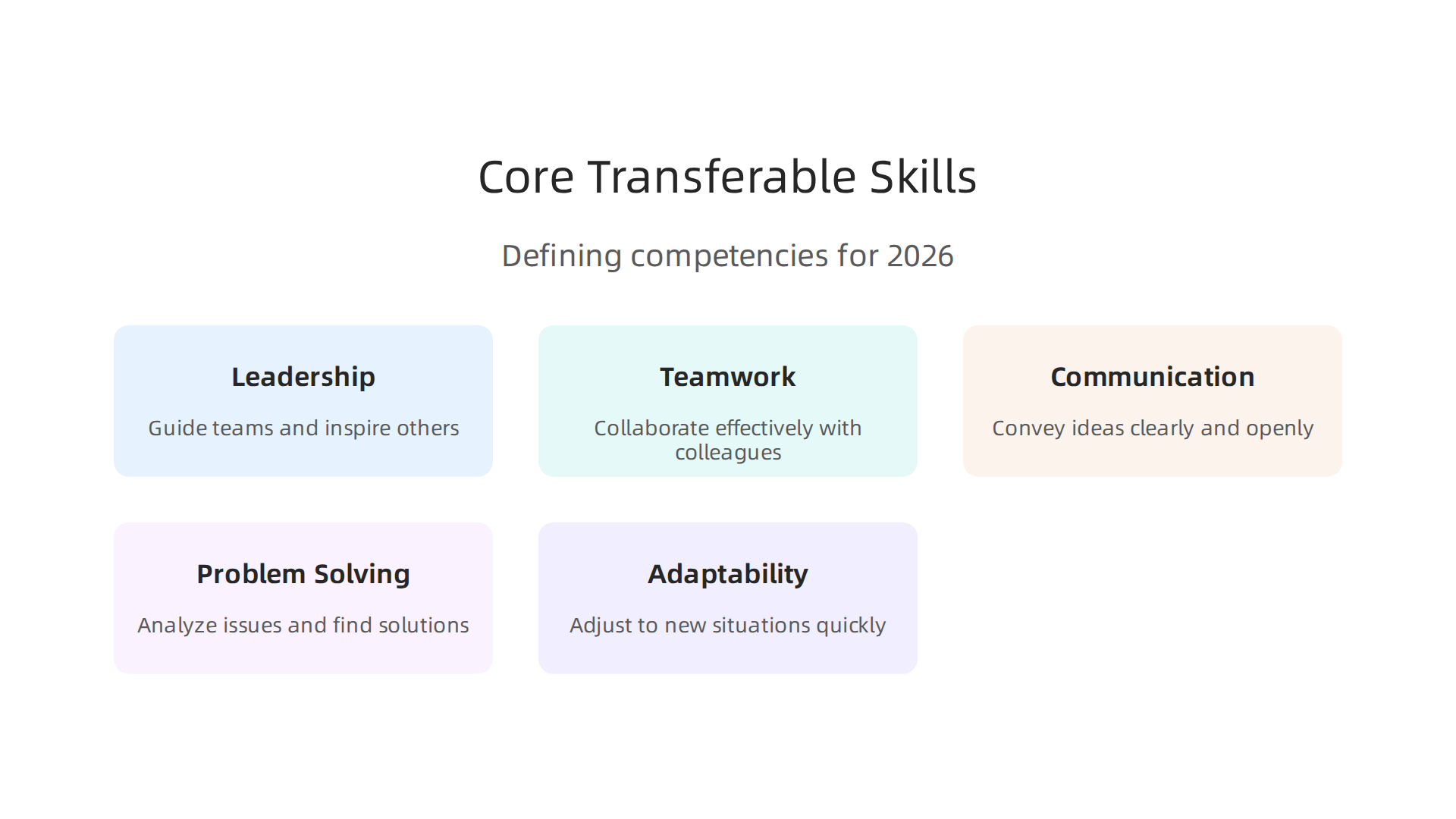
Employers in 2026 list these as some of the most valued attributes they look for when hiring. And here is the key difference. Transferable skills are not the same as technical skills or hard skills.
Hard skills examples include things like coding, accounting, or operating a specific machine. Those are job specific. You learn them for one role, and they might not help much in a different career. Transferable skills, on the other hand, work everywhere. A person with strong organizational skills can keep a project on track whether they work in marketing, healthcare, or construction.
You might hear people call them "soft skills." But that term undersells their value. Transferable skills are concrete. They show up in how you handle conflict, how you lead a meeting, and how you adapt when plans change. Research from City University describes them as objective abilities you have demonstrated through your success at work.
Now here is what has changed in 2026. Remote and hybrid work have made some transferable skills more important than ever. Digital collaboration, proactive communication, and self management matter a lot when your team is spread across time zones. And with AI tools handling more routine tasks, critical thinking and creative problem solving have become top priorities for employers.
So when you think about building your team’s skills, focus on the ones that travel. The ones that work no matter what tools or technologies come next. That is where leadership courses and training in communications pay off the most. They build foundations that last.
Want to start spotting these skills in action today? Try team building games that work for any team setting. They reveal hidden strengths you might have missed.
The Skills Gap Crisis: Why Organizations Are Prioritizing Transferable Skills
Here is the hard truth for 2026. Employers need transferable skills more than ever, but too many workers do not have them. This gap is not small. It is costing companies money, slowing down innovation, and driving good people out the door.
The data paints a clear picture. A recent HR Dive survey found that skills, not pay or benefits, are the biggest obstacle to filling open jobs.
At the same time, the National Association of Colleges and Employers reports that 70% of employers now use skills-based hiring, up from 65% just last year. That means they are looking past degrees and focusing on what people can actually do. And what they want most? Abilities like adaptive thinking, digital literacy, and collaboration. Studies from 2026 confirm that AI collaboration and critical thinking top the list.
The Real Cost of the Gap
When teams lack these core competencies, the effects ripple everywhere. Productivity drops because people cannot communicate clearly or solve problems without handholding. Attrition rises when employees feel stuck or unsupported. And innovation stalls because no one knows how to adapt when plans change.
Think about a real scenario. A project manager with strong organizational skills can keep a remote team on track across time zones. Without that skill, deadlines slip, stress builds, and the team starts looking for new jobs. That is the skills gap in action.
What Is Driving This Crisis?
Three big forces are making the gap worse in 2026.
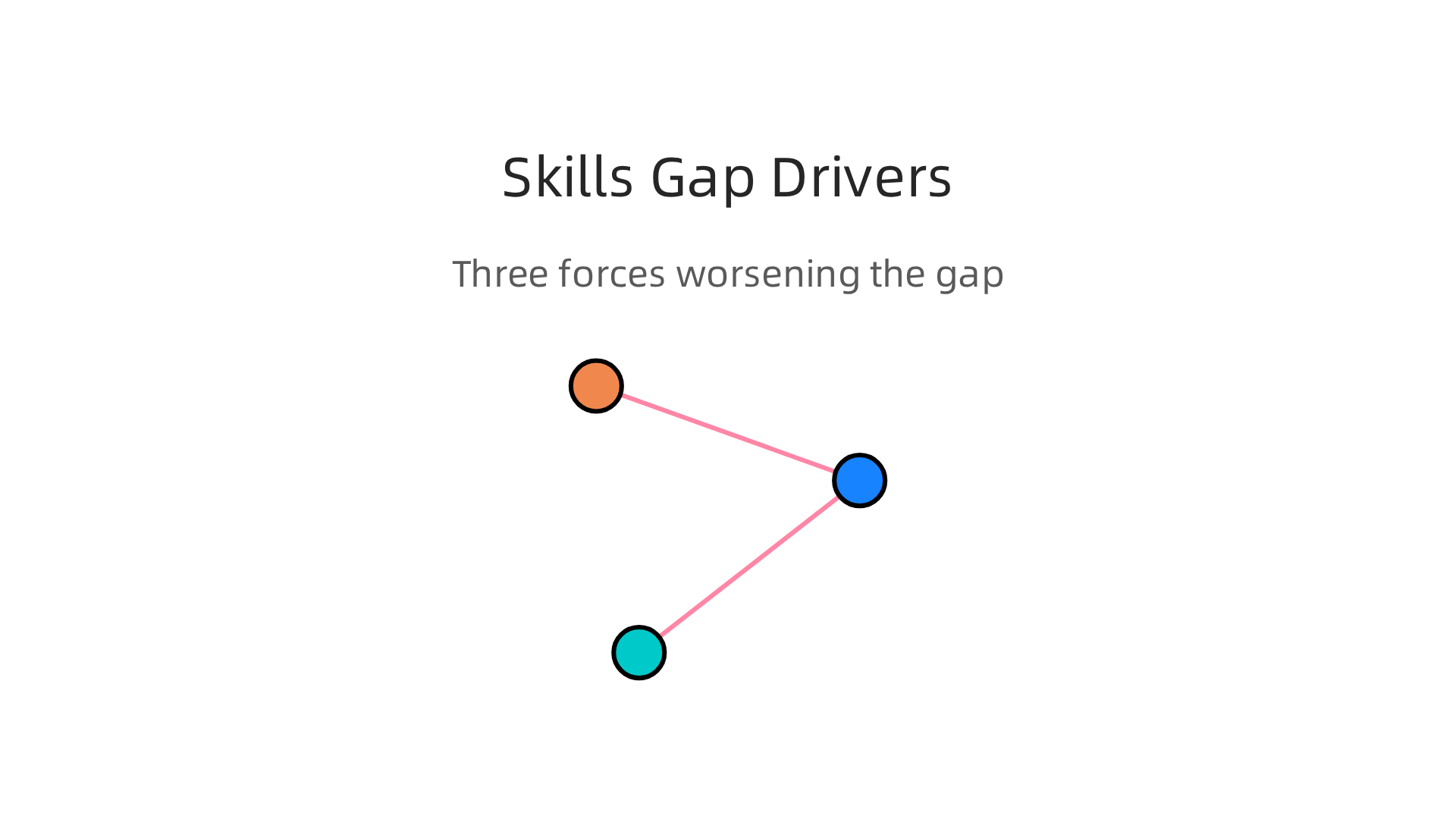
First, rapid automation. AI tools now handle many routine tasks. That means the work left for humans requires judgment, creativity, and emotional intelligence. Mercer’s research on future skills emphasizes that analytical thinking and resilience are becoming core demands.
Second, generational shifts. Millennials and Gen Z workers prioritize purpose, flexibility, and growth. They want to work for organizations that invest in their development. If you do not offer leadership courses or training in communications, they will leave.
Third, the gig economy. More people work as freelancers or on short-term contracts. These workers need transferable skills to land their next role fast. They do not have time for long onboarding. They have to show up ready on day one.
How Smart Organizations Are Responding
The best companies are not just complaining about the gap. They are closing it. They invest in ongoing training that builds the human skills that machines cannot replace. They also use team-building activities to surface hidden talents and strengthen trust. If your team struggles with communication, try some low-prep group games for adults to see who steps up as a natural leader.
The skills gap is real, but it is solvable. Start by understanding what your team needs most, then make a plan to build those abilities today.
Explore Activities for ready-to-use exercises that develop the transferable skills your organization needs to thrive.
Top 10 Transferable Skills Every Employee Should Develop in 2026
The previous section showed you why the skills gap is a real problem. Now let’s talk about the solution. Based on current employer demand and expert research, here are the top 10 transferable skills you and your team should focus on in 2026.
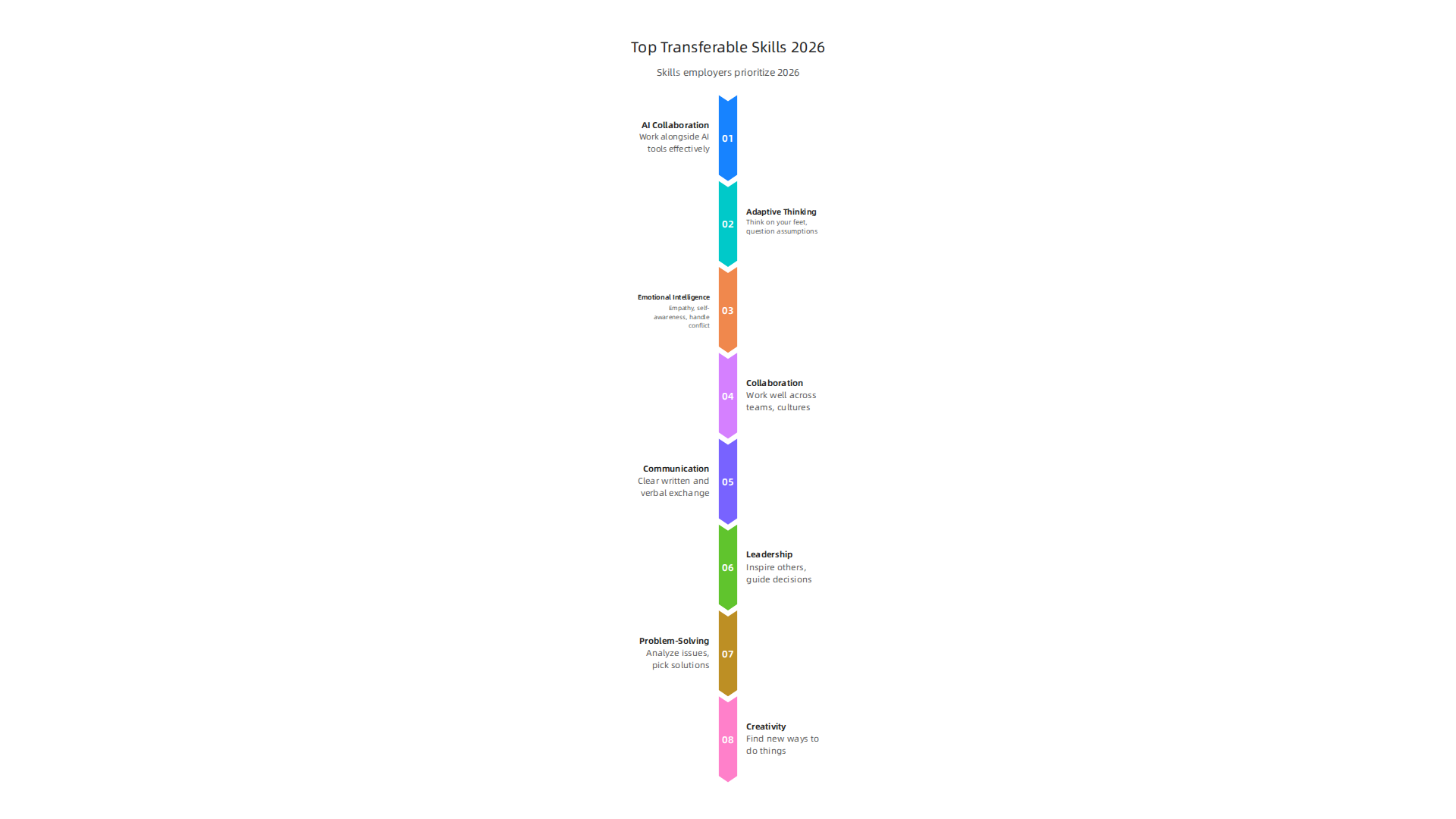
These are the abilities that work in almost any role, industry, or company size. And they are the ones employers are actively looking for when they fill open positions.
1. AI Collaboration and Digital Literacy
You do not need to be a programmer. But you do need to know how to work alongside AI tools. That means knowing when to use ChatGPT, how to check its output, and how to automate routine tasks. In 2026, this is not optional anymore. Studies confirm AI collaboration is now a top demand. Example: A marketing coordinator uses an AI tool to draft social posts, then edits them to match the brand voice. That saves hours each week.
2. Adaptive and Critical Thinking
Plans change fast. Teams pivot. New tools appear overnight. The ability to think on your feet and question assumptions is gold. Employers rank critical thinking as a core demand alongside resilience. Example: A product manager spots a flaw in a launch timeline, quickly suggests an alternative, and keeps the project on track.
3. Emotional Intelligence
Hard skills may get you hired, but soft skills like empathy, self-awareness, and social awareness keep you there. Emotional intelligence helps you read a room, handle conflict, and support teammates. Example: A team lead notices a colleague seems stressed, checks in privately, and adjusts deadlines to reduce pressure.
4. Collaboration and Teamwork
Working well with others never goes out of style. But in 2026, it means collaborating across time zones, cultures, and tools. Teamwork is consistently listed among the most in-demand transferable skills. Example: A designer and a developer from different continents finish a feature together using shared documents and async video updates.
5. Communication
Both written and verbal. Clear communication avoids misunderstandings and builds trust. Training in communications is a priority for forward-thinking organizations. Example: A remote worker writes concise daily updates that help the whole team know what is happening without extra meetings.
6. Leadership and Influence
You do not need a title to lead. Influence comes from inspiring others, taking initiative, and guiding decisions. Leadership courses are valuable for developing this skill. Example: A junior analyst proposes a better way to run weekly reports, gets buy-in from peers, and implements the change.
7. Problem-Solving
Problems are everywhere. The people who can break them down, analyze options, and pick a solution are always in demand. Problem-solving is a key skill in skills-first hiring. Example: A customer support rep finds a workaround for a recurring bug and shares the fix with the whole team.
8. Creativity
Creativity is not just for artists. It is about finding new ways to do things, whether that is a marketing campaign or a process improvement. Example: A logistics coordinator redesigns the warehouse layout to cut picking time by 20%.
9. Resilience and Adaptability
Change is constant. Resilience means bouncing back from setbacks and staying productive under stress. Mercer’s research emphasizes resilience as a core future skill. Example: A salesperson loses a big deal but immediately starts prospecting new leads instead of dwelling on the loss.
10. Continuous Learning
The willingness to keep learning new things is perhaps the most important skill of all. The half-life of hard skills is shrinking. But if you are curious and open to growth, you will always stay relevant. Example: An accountant takes an online course on data visualization to better present financial reports.
How to Build These Skills in Your Team
You do not need a big budget or a training department. Start with simple daily habits. Use team meetings to practice communication. Encourage cross-functional projects to build collaboration. And try low-stakes activities that let people practice these skills in a safe space. For example, team building games that actually work for in-person, virtual, and hybrid teams can help build trust and problem-solving in under an hour.
Explore Activities for ready-to-use exercises that develop the transferable skills your team needs most.
How to Assess Transferable Skills in Your Workforce
Knowing which transferable skills matter is only half the battle. The real challenge is figuring out who actually has them. Self-assessments are a start, but they often miss the mark. People tend to overestimate their own abilities or downplay strengths they take for granted. To get a true picture, you need more reliable methods.
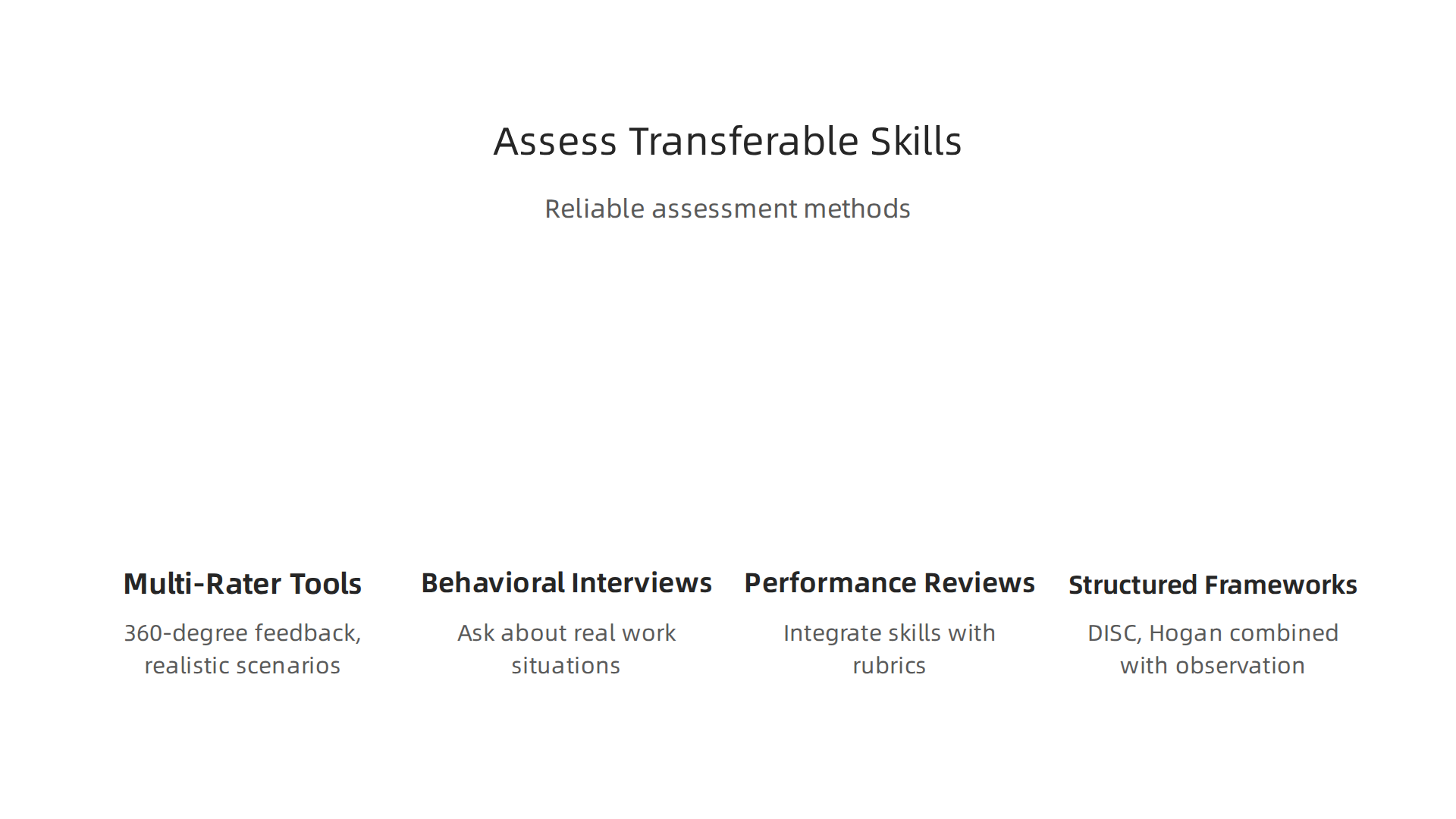
Use Multi-Rater Tools and Simulations
Instead of one person’s opinion, gather feedback from peers, managers, and direct reports. This 360-degree view catches blind spots and reveals patterns. Better yet, create realistic scenarios. Put an employee in a simulated tough negotiation or a fast-changing project timeline and watch how they react. Skill assessment tools like situational judgment tests and cognitive ability tests are designed to measure these behaviors directly, not just what someone says they would do.
Behavioral Interviews Reveal Past Patterns
Ask about real situations: "Tell me about a time you had to adapt to a sudden change at work." The way someone answers tells you a lot about their critical thinking, resilience, and communication skills. This approach digs deeper than hypothetical questions. Transferable skills analyses often use this same structured questioning to connect past experience with future roles.
Integrate Skills into Performance Reviews
Make transferable skills a standard part of your regular reviews. Use simple rubrics that define what good looks like for each skill. For example, instead of just "collaboration," break it down: shares information proactively, gives credit to others, adapts communication to the audience. This turns abstract concepts into measurable behaviors.
Leverage Structured Frameworks
Tools like DISC and Hogan Assessments can give you a baseline. But remember, they are just one piece. Combine them with on-the-job observations and peer feedback for a complete picture. The goal is not to label people, but to identify growth areas.
Once you know where the gaps are, you can start building those skills. Simple structured activities are a great way to practice communication and problem-solving in a low-pressure setting. Try free play team building activities to see transferable skills in action and spark real improvement.
Explore Activities for ready-to-use exercises that help you assess and develop the transferable skills your team needs most.
Developing Transferable Skills: Proven Strategies and Programs
Assessment is just the first step. Once you know what your team has, the real work begins: building those skills intentionally. The good news? You do not need expensive consultants or giant budgets. A smart, low-cost program can make a real difference.
Use a Blended Learning Approach
People learn in different ways. So mix it up. Use microlearning for quick wins. Short videos or reading that take five minutes can teach a new concept, like how to give better feedback. Then follow up with experiential projects. Have someone lead a real project where they must use their organizational skills to keep things on track. Pair this with mentoring and peer coaching. A senior team member can guide a junior one on leadership courses topics like delegating work. This combination works far better than a single workshop.
For teams on a budget, focus on what is free. Internal mentoring costs nothing. Peer coaching uses people you already have. You can find free resources for training in communications online. The real investment is time and consistent practice. A structured transferable skills analysis can help you identify which skills to prioritize so you do not waste effort.
Design a Low-Cost, High-Impact Program
Keep it simple. Pick two or three transferable skills your team needs most. Maybe that is hard skills examples like data analysis or organizational skills like project management. Build a three-month plan:
- Month one: Self-study with microlearning and short videos.
- Month two: Apply the skill in a small team project.
- Month three: Peer review and mentoring session to reflect on growth.
This low-pressure cycle builds confidence without overwhelming anyone. Team building activities are a perfect way to practice these skills in a safe environment. They let people try new behaviors without real-world consequences.
The Role of L&D Teams
Learning and development teams act as curators. They do not need to create everything from scratch. Instead, they find the best resources, build a clear skills taxonomy, and map out growth paths for each role. This makes it easy for managers to see how a skill like emotional intelligence connects to a promotion path. The top transferable skills employers want in 2026 include AI collaboration and adaptive thinking. L&D teams can surface resources for these high-demand areas.
Explore Activities to find ready-to-use exercises that help your team build exactly these skills.
Fostering a Culture That Cultivates Transferable Skills
Programs are great. But culture is what makes transferable skills stick. Even the best leadership courses or training in communications modules fail if the environment does not support growth. Here is how to build that culture.
Lead with Trust and Psychological Safety
People only try new skills when they feel safe to fail. That starts at the top. When managers show curiosity and admit mistakes, teams follow.

Fostering a culture of transparency and trust is essential for engaging employees, especially in hybrid teams. Psychological safety is the foundation of successful hybrid collaboration. Without it, skill training has little impact.
Embed Skill Development Into Daily Work
The best way to grow transferable skills? Use them. Give team members stretch assignments. Let someone with strong organizational skills lead a challenging project. Create cross-functional projects where people learn new hard skills examples like data analysis. Start rotation programs so team members spend time in other departments. These experiences build real ability faster than any workshop.
Recognize and Reward Growth
What gets rewarded gets repeated. Tie recognition to skill acquisition. Celebrate when someone completes a training in communications course or applies a new leadership courses technique. Make it visible. A quick shoutout in a meeting costs nothing but reinforces the message. Skills-based development should be a central focus. Align your reward system to this goal.
Use Team Activities as Practice
Structured exercises let people test skills without real pressure. Team building games that work for any setting help teams practice communication and collaboration in a fun way. Those skills then transfer to real projects.
Explore Activities to find exercises that build exactly these skills in your team.
Transferable Skills for Remote and Hybrid Teams
The way we work has changed. Remote and hybrid setups are now common. And they change everything about which transferable skills matter most.
Here is the thing. When your team is spread across different locations, old habits stop working. You cannot tap someone on the shoulder. You cannot read body language in a chat window. So certain skills become non negotiable.
The Skills That Matter Now
In a remote or hybrid environment, three skills stand out above the rest.
Self-management is huge. Without a manager walking by your desk, you need to stay focused and organized on your own. This is where organizational skills come into play. People who can manage their time and priorities thrive in this setting.
Written communication takes center stage. Most conversations happen in Slack, email, or project management tools. If you cannot write clearly, misunderstandings pile up fast. That is why training in communications is one of the best investments you can make for your team.
Virtual collaboration is also key. Running a productive video meeting, giving feedback across time zones, and keeping projects moving without face to face contact all require practice. Many leadership courses now focus specifically on these remote collaboration skills.
The Real Challenges
Building trust without physical proximity is hard. It takes intentional effort. Leaders who can foster a culture of trust and collaboration have greater success with hybrid teams. That is a proven fact.
Another challenge is informal learning. In an office, you pick up hard skills examples just by overhearing conversations or watching colleagues solve problems. Remote teams lose that. You have to create structured ways for learning to happen.
Team cohesion also suffers when people rarely meet. Maintaining workplace culture across hybrid teams requires intentional effort, like creating rituals that include everyone regardless of location.
Tools and Practices That Help
Here are practical solutions that work in 2026.
Async communication norms make a big difference. Set clear expectations about response times. Use documents instead of meetings when possible. This respects everyone’s time and reduces burnout.
Virtual team-building activities are not optional. They are essential. Structured exercises let people practice collaboration without the pressure of real work. Games designed for hybrid teams build connection and trust.
Digital upskilling platforms help bridge the learning gap. Give your team access to online courses where they can build new skills on their own schedule.
If you need ideas for virtual activities that actually work, check out these team building games designed for any setting.
They are perfect for remote and hybrid teams.
The bottom line is this. Remote and hybrid work is not going away. The teams that succeed will be the ones that intentionally build these transferable skills into their daily routines.
Ready to find more ways to strengthen your remote team? Explore Activities to discover exercises that build connection and collaboration in your team.
Measuring the ROI of Transferable Skills Development
You know building transferable skills matters. But here is the question every leader dreads. How do you prove it to the people who control the budget?

Measuring ROI on skills development is tricky, especially with soft skills. But it is absolutely doable. And in 2026, with budgets tighter than ever, you need the numbers to back up your requests.
The Metrics That Actually Count
Start with the data that leaders pay attention to.
Time-to-productivity is a strong signal. When new hires work on their organizational skills and communication early, they contribute faster. Companies that invest in targeted training earn 218% higher income per employee. That number comes from ATD data cited in a 2026 corporate training report.
Retention is another big one. People stay when they feel valued. Investing in learning and development programs directly improves job satisfaction and retention rates.
Internal mobility also shows real ROI. When you build skills from within, you fill senior roles without expensive external searches. Track how many employees move into new positions after completing leadership courses or other training.
The Soft Skills Problem
Here is the honest challenge. You cannot put emotional intelligence on a spreadsheet. So do not try.
Instead, use two types of indicators together.
Leading indicators tell you if things are moving in the right direction. Engagement scores, 360 feedback, and participation rates in training in communications all count here. These show early momentum.
Lagging indicators prove the final result. Promotion rates, project quality scores, and lower hiring costs all work. The World Economic Forum predicts 44% of workers’ skills will be disrupted soon. Tracking these lagging numbers helps you prepare your team before that disruption hits.
Making Your Case to Leadership
Connect every skill directly to a business outcome. Better written communication means fewer costly misunderstandings. Stronger self-management means more output per person. Cross-training on hard skills examples creates a flexible workforce that adapts fast.
Strategic workforce development is now a proven driver of organizational success.
Once you identify where your team needs to grow, you need the right exercises to build those skills. Little games for team building give you quick, focused activities that develop the exact transferable skills your team needs most.
Ready to put this into practice? Explore Activities to find exercises that develop the skills your team needs while giving you measurable outcomes to track.
Summary
This article explains why transferable skills — like AI collaboration, critical thinking, emotional intelligence, and communication — are the most valuable currency in today’s fast-changing workplace, especially in 2026. It outlines the causes and costs of the current skills gap, then lists the top 10 skills employers want and real examples of how they show up at work. You’ll find practical methods to assess skills accurately (360 feedback, simulations, behavioral interviews), a simple low-cost three-month program model for building skills, and blended learning tactics that combine microlearning, projects, and mentoring. The piece also covers how to embed skill development in daily work, foster a culture of psychological safety, adapt training for remote and hybrid teams, and measure ROI with leading and lagging indicators like time-to-productivity, retention, and internal mobility. Readers will come away with concrete activities to try, frameworks for evaluating their teams, and metrics to make the business case for investing in human skills.