Team Dynamics What They Really Mean and How to Improve Them

Introduction
You hear the word "team" all the time at work. We talk about "the team" in meetings. We say someone is "a great team player." But what does the word really mean?
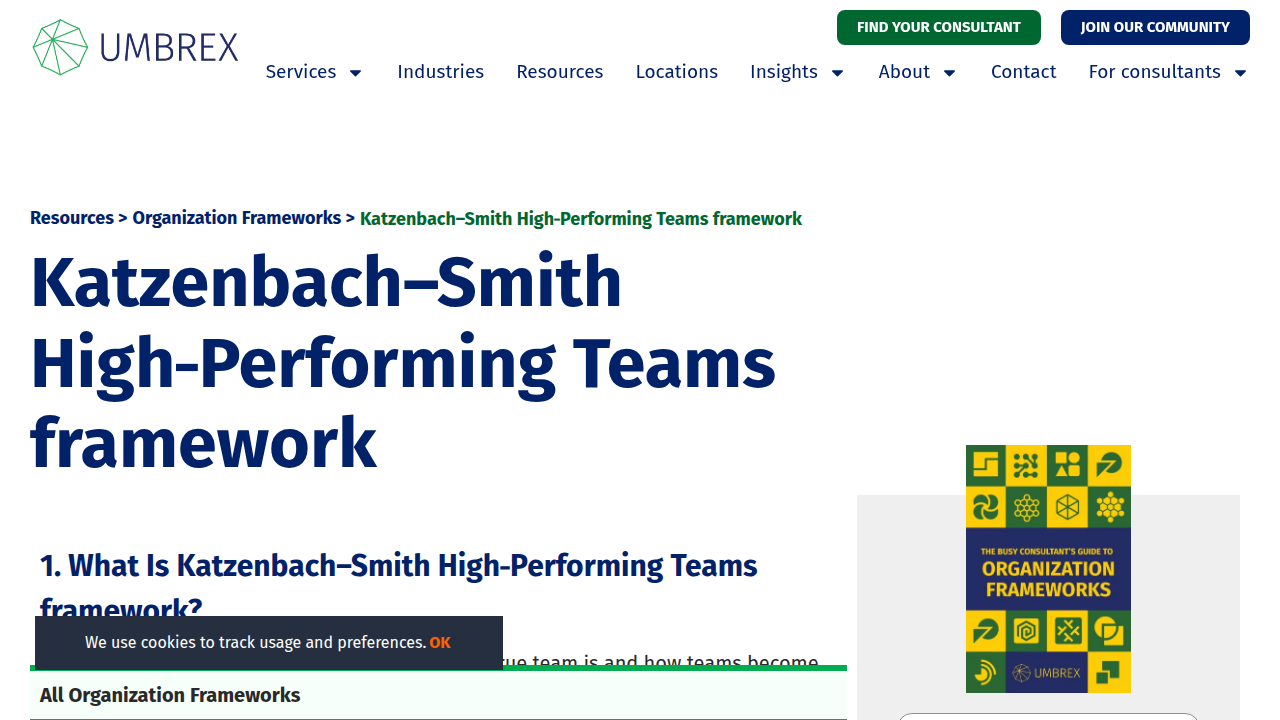
The truth is, many groups that call themselves a team are just working groups. They share goals but do not really depend on each other. Researchers Jon Katzenbach and Douglas Smith spent years studying this. They defined a real team as a small group of people with common goals, shared accountability, and mutual commitment. Their work, known as the Katzenbach–Smith High‑Performing Teams framework, is still a gold standard today.
Why does this matter? Because poor group dynamics cost companies billions each year. Low trust, bad communication, and unclear roles lead to lost time and high turnover. In fact, research shows that an effective team is always worth more than the sum of its parts.

If you want to fix your team’s problems, you first need to know what a real team looks like and what makes it tick.
In this article, we will break down what "the team" really means. We will explore other words for team and their subtle differences. And we will give you a simple framework to diagnose your own group’s dynamics so you can take action.
Whether you lead a group of five or fifty, understanding these basics can save you money and stress. Let’s start with the core question: What is a team, really?
Explore Activities — Browse curated team-building ideas to put these insights into practice.
What Does "The Team" Really Mean? A Clear, Research-Based Definition
So what separates a real team from just a group of people working near each other? The answer is one word: interdependence. A group shares information and makes decisions independently. But a true team depends on each other to reach a shared outcome. Without that mutual reliance, you have a working group, not a team.
In 2026, the most trusted definition still comes from Jon Katzenbach and Douglas Smith. After years of research, they defined a team as "a small number of people with complementary skills who are committed to a common purpose, performance goals, and approach for which they hold themselves mutually accountable." This definition is the gold standard because it highlights the three essentials: common purpose, shared accountability, and commitment to how you work together.
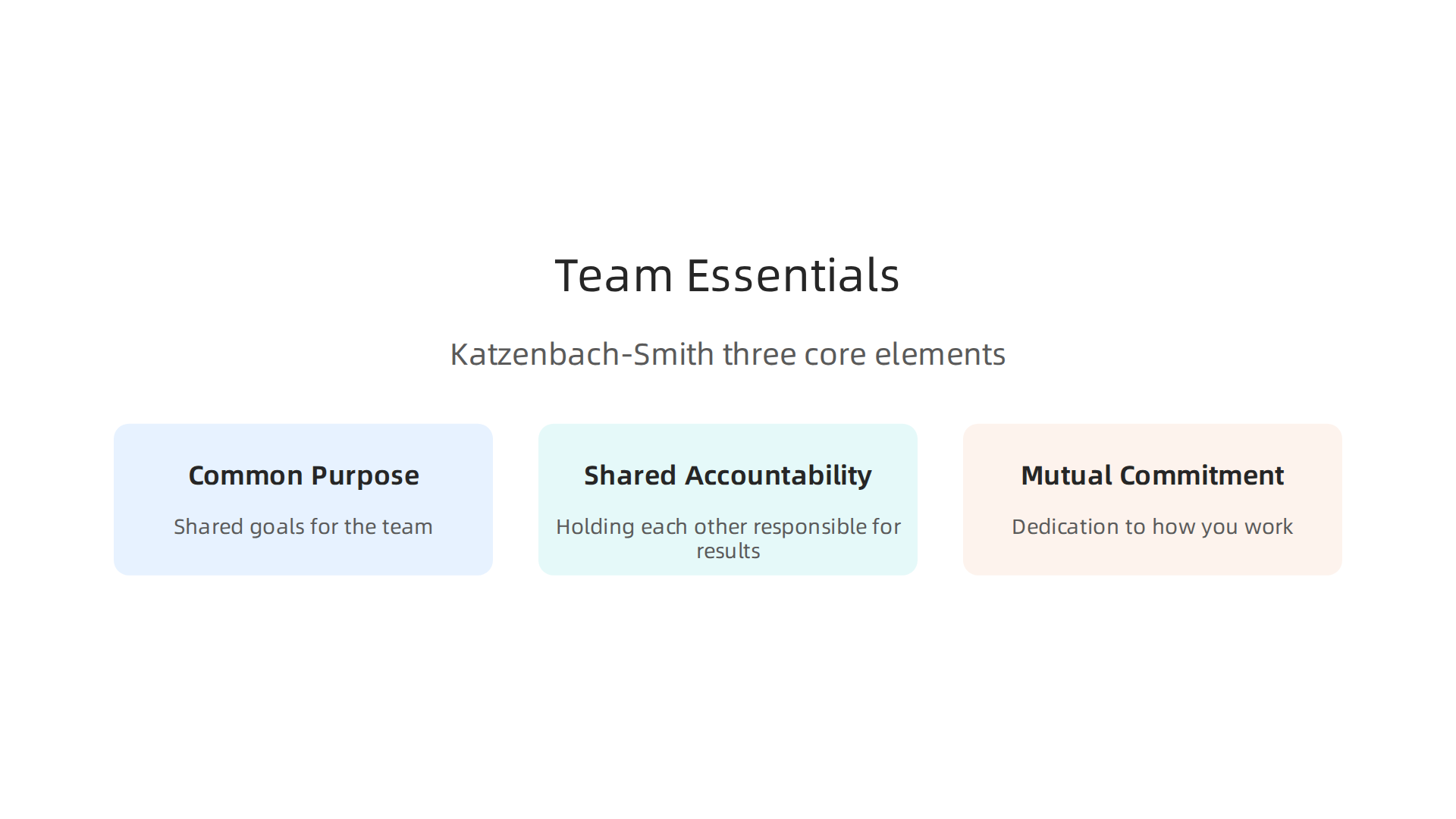
The Katzenbach–Smith High‑Performing Teams framework breaks this down further. A real team has a small size (usually 2 to 25 people). Members bring different skills that fill each other’s gaps. And they do not just report to a boss; they hold each other responsible for results. That is a big shift from the typical "the team" talk in meetings.
Now let’s talk about other words for team. You might hear "crew," "squad," or "unit." Each carries a different feel. A crew often works together on a physical task, like a film crew or a construction crew. A squad sounds more military or sports oriented, with a clear chain of command. A unit feels formal and divisional, like a business unit. But the core idea of interdependence is what makes any of these a real team. If you want to reframe how you talk about collaboration, check out these team building synonyms to reframe your next collaboration session.
Understanding this definition is your first step. Once you know what "the team" really means, you can start building it. For practical ways to bring these ideas to life, explore activities that match your group’s goals and setting.
Group Dynamics: The Invisible Forces Shaping Your Team’s Performance
Ever wonder why some groups click right away while others feel stuck no matter what you try? That is group dynamics at work. These are the invisible forces that shape how people interact, make decisions, and get things done together.
The most trusted way to understand these forces is called Tuckman’s Stages of Group Development. Psychologist Bruce Tuckman created this model in the 1960s to explain how teams grow over time. The model has five stages: Forming, Storming, Norming, Performing, and Adjourning.
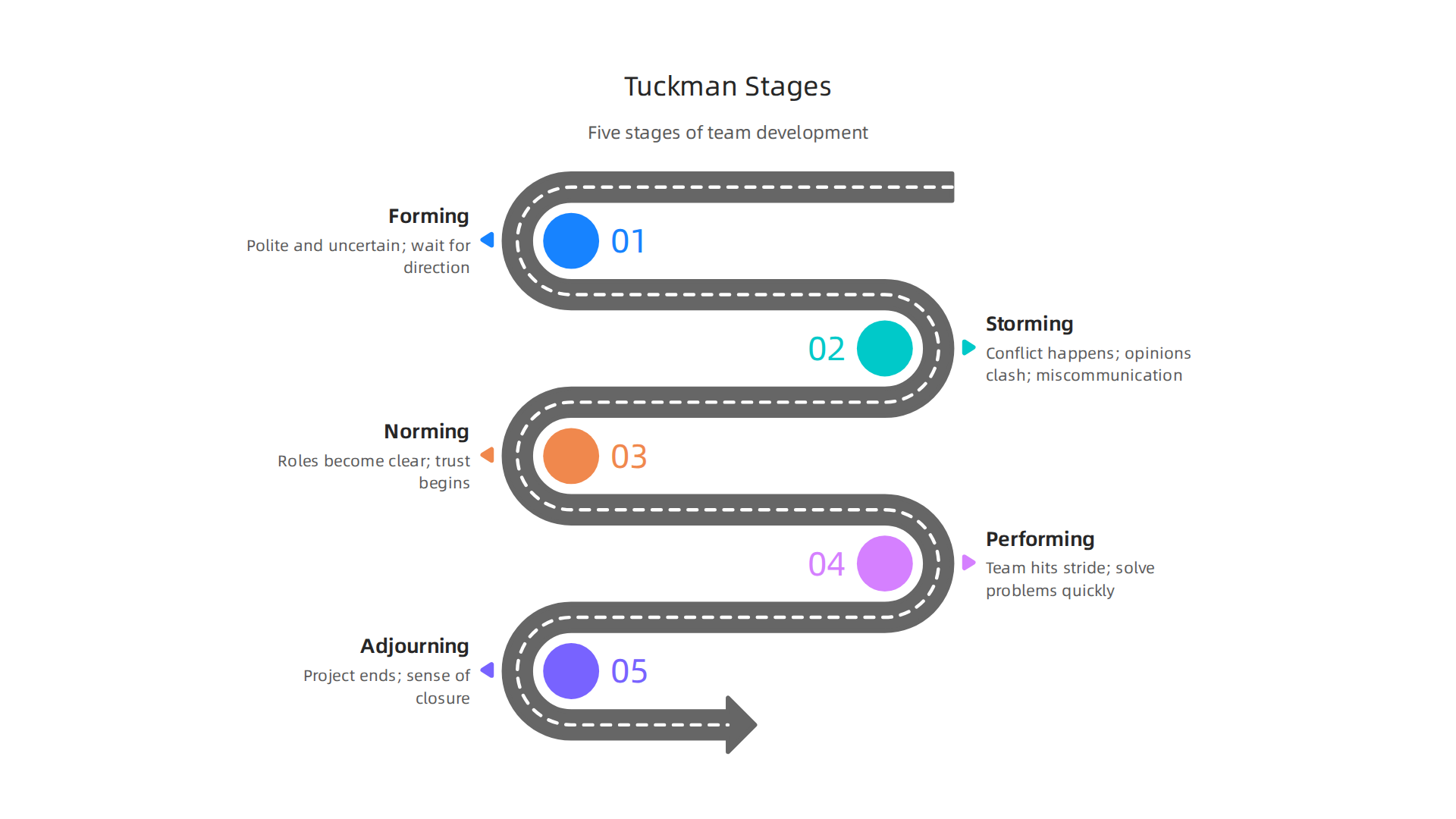
Researchers at MIT still use this framework today to help teams improve their performance.
Here is what each stage looks like in real life:
- Forming. People are polite and uncertain. They wait for direction. Nobody wants to rock the boat yet.
- Storming. This is where conflict happens. Different opinions clash. Miscommunication is high. Many teams get stuck here because the discomfort feels too big.

- Norming. Roles become clear. People start trusting each other. Norms form around how you communicate and work together.
- Performing. The team hits its stride. You solve problems quickly. Trust is high. The group feels like a real team.
- Adjourning. The project ends or people move on. There is a sense of closure.
Why does this matter for your team? Because where you are in these stages directly affects the pain points you feel. If your group struggles with low engagement, you might be stuck in Forming. If miscommunication is a constant problem, you are likely in Storming. The good news is that you can use this model to diagnose what is going wrong and take action.
One key element in every stage is norms. Norms are the unwritten rules about how people behave, speak, and make decisions. When norms are healthy, the team coheres naturally. When they are missing or negative, disconnect grows. You can learn more about how to spot and reshape these patterns in this guide on how to diagnose and reshape team roles and dynamics.
So next time your team feels off, ask yourself: which stage are we in right now? That simple question can point you toward the right fix.
If you want practical ways to guide your group through these stages and build stronger dynamics, explore activities that match where your team is today.
Why Each ICP Must Understand Team Dynamics
Now that you know how groups move through stages, you might wonder: who really needs to pay attention to all of this? The truth is, understanding team dynamics matters for almost everyone who works with people. But four groups in particular see the biggest payoff.
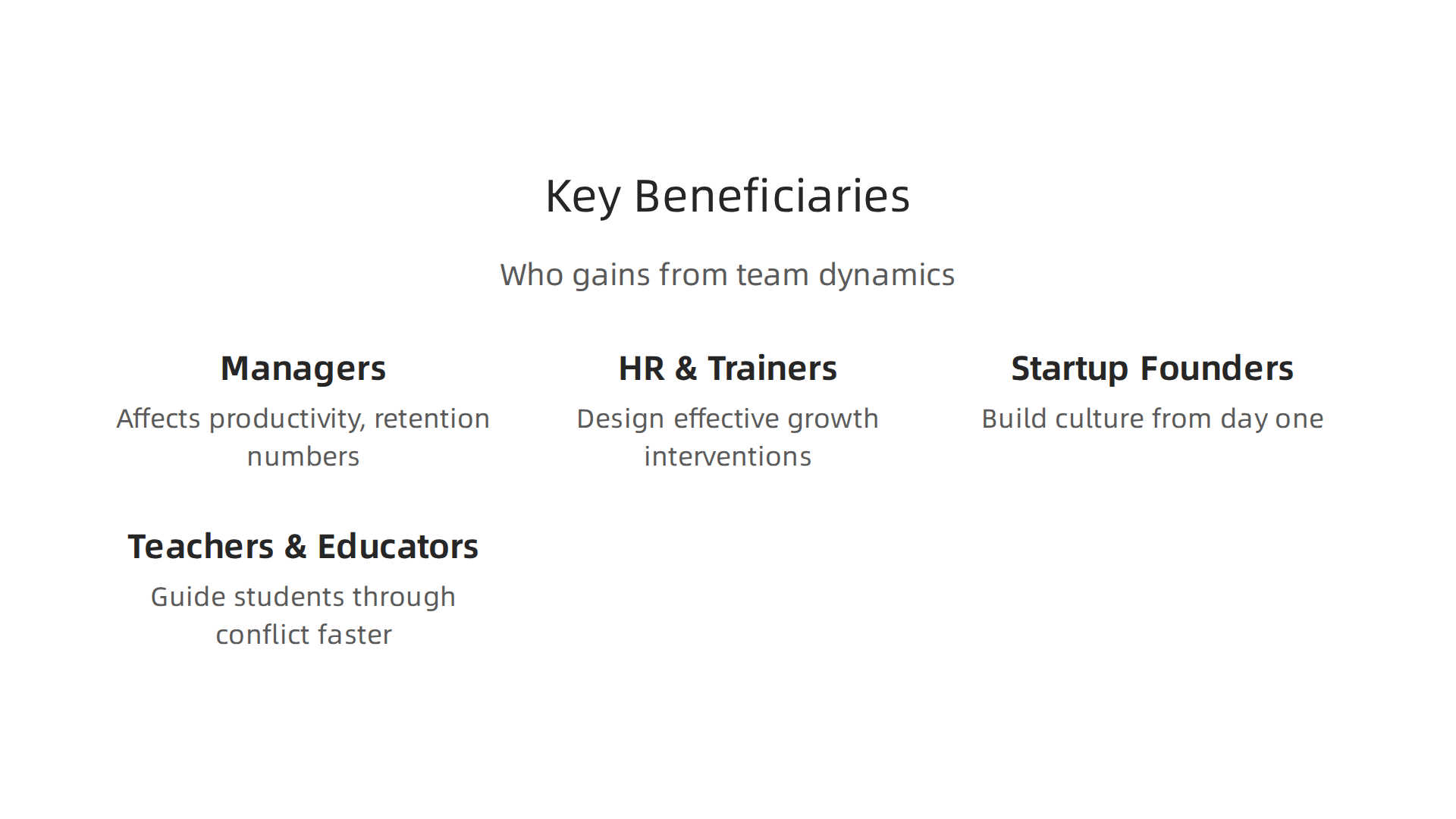
Managers & Team Leaders. If you run a team, dynamics directly affect your productivity and retention numbers. Gallup data shows that low employee engagement costs the world nearly $9 trillion every year. And turnover can be 18 to 43 percent higher in low engagement teams. When you know how to spot which stage your team is in, you can step in before small issues turn into big ones. You also build a culture where people actually want to stay.
HR & Trainers. Your job is to design interventions that help teams grow. But one size does not fit all. A team stuck in Storming needs different support than a team already in Performing. Research from HR.com shows that toxic culture and poor communication are strong predictors of turnover. So when you match your training to the group’s maturity level, you get better results and lower churn.
Startup Founders. You are building culture from day one. That is both a gift and a challenge. Every decision you make about how the group works together sets a norm. And if your team is remote, you have to be extra intentional. Without a shared office, the unwritten rules do not emerge on their own. You have to name them and reinforce them actively.
Teachers & Educators. The same models apply in classrooms. When you adapt Tuckman’s stages for group projects or collaborative learning, you help students move through conflict faster and reach real teamwork. That builds skills they will use for life.
No matter which group you belong to, understanding these forces helps you lead better. If you want practical ways to guide your team through each stage, explore activities that match where your group is today.
Common Challenges in Team Dynamics – and How to Overcome Them
Even when you understand the stages teams go through, everyday hurdles still get in the way. Poor communication, low morale, disconnect in remote settings, rocky onboarding, and tight budgets or time constraints show up again and again. The good news is that each challenge is also an opportunity for a targeted team-building intervention.
Take poor communication. Pumble’s 2026 workplace statistics show that 25% of employees report having a poor customer experience because of communication breakdowns at work. Toxic culture and poor communication are also strong predictors of turnover, according to HR.com’s State of Employee Retention 2025‑26. When you address those issues head‑on with structured activities, you don’t just fix the symptom; you build a stronger foundation.
Low morale and disengagement are equally costly. Gallup data cited by Archie estimates that low engagement costs the world nearly $9 trillion a year, and turnover is 18%–43% higher in low‑engagement teams. Instead of letting morale slide, use exercises that rebuild trust and connection. For example, free‑play team‑building activities can help the group reconnect without pressure.
Even onboarding and budget constraints can be turned into wins. Simple, low‑cost icebreakers and quick games fit any schedule and help new members feel included fast. For a lighthearted way to spark conversation and improve morale, Read Book 1 as a team and see how shared laughter shifts the dynamic.
General Communication and Engagement Issues
When communication breaks down, the team feels the pain. Misunderstandings cause project delays. Friction builds between coworkers. And trust starts to fade.
The numbers show how big this problem really is. Pumble’s 2026 workplace data reports that 25% of employees say poor communication at work leads to bad customer experiences. HR.com’s State of Employee Retention 2025-26 confirms that toxic culture and poor communication are strong predictors of turnover. When the group stops talking openly, people start looking for the door.
Low engagement makes things even worse. Gallup data cited by Archie shows that low engagement costs the global economy nearly $9 trillion each year. Teams with low engagement also see turnover rates 18% to 43% higher than highly engaged teams. That is a massive hit to both morale and the budget.
Managers often feel stuck. You know other words for team like "crew" or "squad," but what you really need are activities that work without eating up your schedule. The good news is that simple, low-prep exercises can make a real difference. For quick ideas that fit any timeline, try these team building games that work for any setting.
If you are short on time and need proven activities, Explore Activities for curated exercises that take the guesswork out of planning.
Remote and Hybrid Team Disconnect
Remote work is here to stay. But here is the problem. When the team stops bumping into each other by the coffee machine, something important gets lost.

Studies show that teams working in separate locations experience lower levels of trust and higher levels of conflict compared to co-located teams. That is a big deal. Without the casual conversations that happen naturally in an office, the group can start to feel like a collection of strangers rather than a real team.
Harvard Business Review research found that organizations that prioritize virtual team cohesion see a 25% increase in overall effectiveness. The reverse is also true. When you ignore the disconnect, engagement drops and turnover climbs.
Onboarding new hires in a remote setting is especially tough. New team members miss out on the hallway chats and informal mentoring that help people feel like they belong. Without structured activities, it can take months for a new person to truly feel part of the group.
And time zones add another layer. A quick 10 minute icebreaker for one person means a 6:00 AM meeting for another. Remote team building must be intentional and fair for everyone involved.
The good news? Simple virtual activities make a real difference. Start with exercises designed for hybrid settings. For practical ideas that fit across time zones, check out these team building games that actually work for in person, virtual, and hybrid teams.
If you need ready to go activities that take the planning off your plate, Explore Activities for curated exercises designed by facilitators who understand remote team challenges.
Synonyms for "The Team" – When and How to Use Them
Here is a simple truth. The word you use to describe the group changes how people act.
You might call everyone "the team" by default. But not every group of coworkers is a real team.
Researchers Katzenbach and Smith studied this closely. They defined a true team as a small number of people with complementary skills who share a common purpose and hold each other mutually accountable. That is a high standard.
So when you use other words for team, you actually set clearer expectations. Let us look at common synonyms for team and when each one works best.
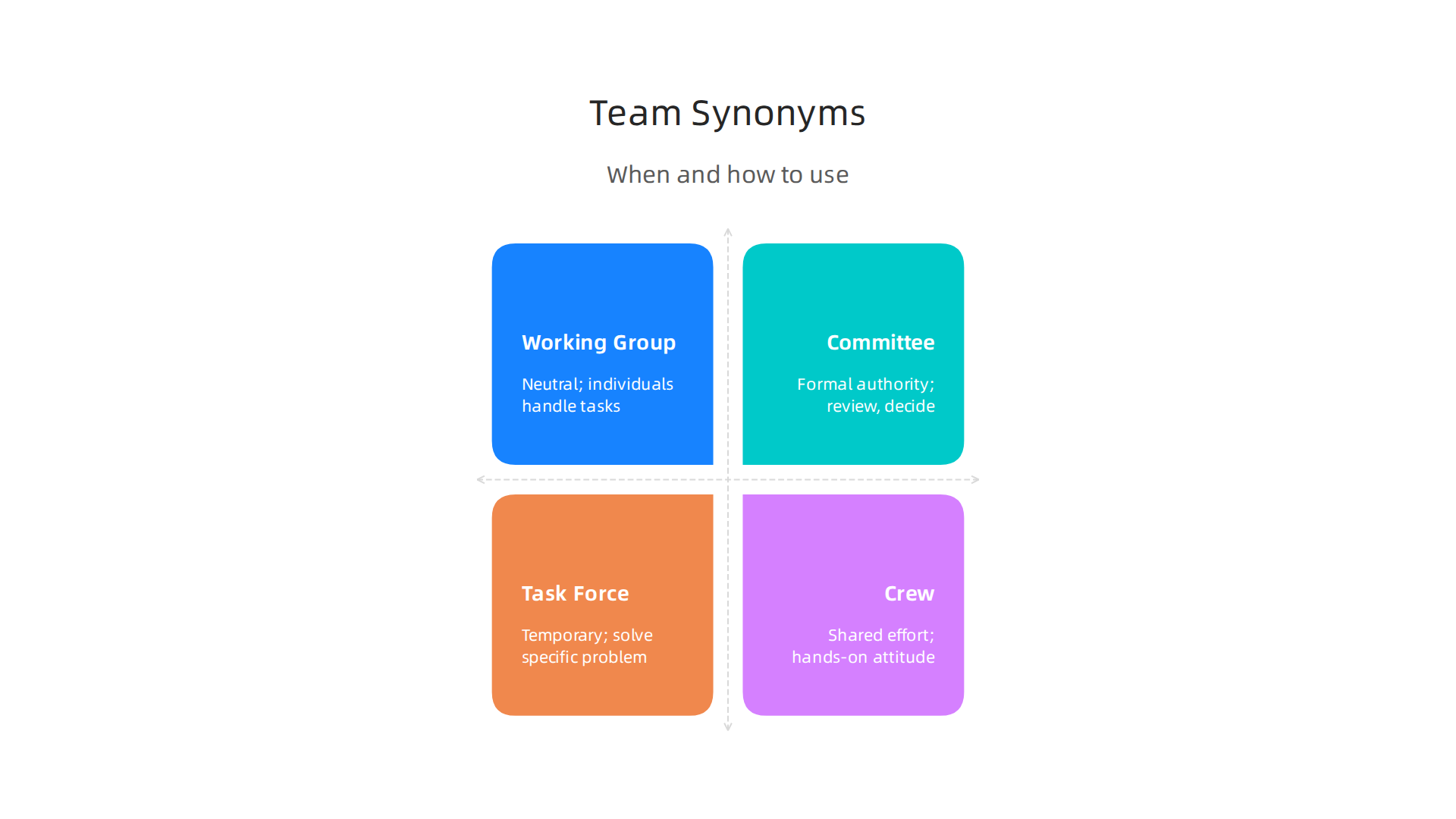
- Group or Working Group: This is the most neutral option. People work near each other but mostly handle their own tasks. There is less need for shared decision making. Katzenbach and Smith used the Umbrex framework to explain that a working group relies on individual contributions, not collective work products.
- Committee: This word signals formal authority. Think of a safety committee or a steering committee. Their main job is to review information and make decisions.
- Task Force: This one is temporary. A task force forms to solve a specific urgent problem. Once the problem is solved, the group disbands.
- Crew: Calling people a "crew" implies shared effort and a hands-on attitude. It works great for operational teams or project based work.
- Squad: This feels smaller and tighter. A squad has high trust, strong bonds, and a real sense of belonging.
- Partnership or Alliance: These words suggest a formal relationship between people or even between different organizations.
Why does this matter for you?
If you call a loosely connected group a "team," you create confusion. They might resist expectations of deep collaboration. But if you call a high trust unit a "squad," you reinforce that tight bond.
For deeper insight on how labels affect behavior, read our guide on how to diagnose and reshape team roles and dynamics.
Actually, choosing the right word is just the start. Once you set the label, you need shared experiences that match. If you want your "crew" to feel more connected, a fun shared story helps. It gives the group an inside joke and something to talk about.
Read Book 1 – a clever sci-fi comedy that turns a group of individuals into a real crew.
Why Investing in Team Dynamics Pays Off
You might wonder if spending time and money on team dynamics is worth it. The answer is yes, and the numbers prove it.
Companies that invest in team building see a 25% boost in overall team performance.

That is according to data from Peak Sales Recruiting.

Regular team activities also lead to a 14% increase in productivity and a 23% rise in profitability, based on High5Test research.
These aren’t small gains. Better dynamics mean fewer misunderstandings, faster project delivery, and lower turnover. Purpose-driven team events can deliver 87% higher employee retention. That saves you serious money on hiring and training.
The best part? You don’t need expensive retreats or consultants. Even low-cost activities produce measurable improvements when you match them to your team’s current stage. A simple icebreaker or a structured problem-solving game can shift how people work together. For example, teams that improve their communication reduce costly errors and conflicts, as shown by The Country Castle Company.
Think of it this way. When you invest in how the group operates, you are investing in your bottom line. Higher engagement leads to better ideas and stronger results. And when people feel connected to each other, they stay longer and contribute more.
Ready to see what works for your team? Start with simple, proven ideas. Check out our collection of team building games that actually work to find activities that fit your setting and goals.
Practical Tools to Diagnose and Improve Your Team’s Dynamics
Knowing that better dynamics pay off is one thing. Figuring out where your specific group is struggling? That takes a different toolset. The good news is that researchers have created simple assessment methods you can use right now.
Three tools stand out for diagnosing what is really going on with the team:
1. The Team Diagnostic Survey
This tool maps where the group sits on Tuckman’s stages of development. It helps you see if you are stuck in Storming or ready to move toward Performing. A validated version of this questionnaire exists specifically for team settings, as shown in research from Virginia Tech. When you understand your current stage, you can pick activities that match where you actually are.
2. Lencioni’s Trust Checklist
Patrick Lencioni’s model focuses on the five dysfunctions of the team, starting with absence of trust. A quick checklist helps you spot whether your group lacks vulnerability-based trust. If trust is low, no amount of task planning will fix the real problem.
3. Google’s Project Aristotle Framework
Google’s research found that psychological safety is the number one predictor of high-performing the group. Their framework gives you practical questions to measure safety levels. Teams that score low on safety often struggle with the same issues that show up in Lencioni’s model.
The catch is this. Assessment tools only show you the gap. They do not close it. That is where facilitated activities come in. A diagnostic without follow up is like taking a temperature and never treating the fever. You need to pair your findings with structured exercises that build trust, improve communication, and push other words for team members through the next stage of development.
Start by running a quick assessment. Then pick one or two targeted activities to address what you discovered.
Tools and Activities for Remote Teams
The same diagnostic tools from the previous section work for a remote the team, but you need to adapt them for distance. Studies show that teams working in separate locations face lower trust and higher conflict than co-located groups. So here is how to pair assessment with action for the group that never meets in person.
Virtual versions of classic team-building. Try online escape rooms, virtual coffee chats, or shared challenges like a step‑based walking contest. A recent roundup of 20 remote team‑building activities includes options that build real connection through screens.

For more ideas, explore our list of virtual team building activities that work.
Asynchronous activities for global teams. When your other words for team span multiple time zones, live sessions are tough. Use weekly pulse surveys and async 1‑on‑1 check‑ins to stay connected without forcing everyone awake at 3 a.m. Tools like these help you diagnose issues faster, as noted in a 2026 guide on remote team challenges.
Assessment adapted for remote: cohesion measurement surveys. Adapt the diagnostic surveys from earlier by running them through a simple anonymous form. Research shows that organizations that prioritize virtual team cohesion see a 25% increase in performance. Measure where your synonyms team (distributed group, remote crew) stands, then act on the results.
Summary
This article explains what makes a real team versus a mere working group, using research-backed definitions from Katzenbach and Smith and practical models like Tuckman’s stages. It describes the invisible dynamics that drive team performance—interdependence, norms, trust—and shows how to diagnose where your group is stuck (Forming, Storming, Norming, Performing, Adjourning). The piece highlights common pain points—poor communication, low engagement, remote disconnect—and gives pragmatic, low‑cost ways to fix them through targeted activities and rituals. It also clarifies when to use different labels (squad, crew, task force) to set expectations and recommends assessment tools (Team Diagnostic Survey, Lencioni’s checklist, Google’s Project Aristotle) to map gaps. Readers will learn how to read their team’s current state, pick appropriate interventions, and start rebuilding trust and effectiveness quickly.