Team Building Synonyms to Reframe Your Next Collaboration Session

Introduction: Why the Language of Team Building Matters More Than Ever
Have you ever heard the phrase "team building" and felt your energy drain away? You are not alone. Many workers have been through trust falls, awkward icebreakers, and boring workshops that felt like a waste of time. The problem is not with bringing people together. The problem is using the same tired words over and over again.
Here is the thing. When you always say "team building," people start to tune out. They expect the same old thing. But what if you called it a "collaboration workshop" instead? Or a "team alignment session"? The right team building synonym can change how people feel before the activity even starts.
The numbers back this up. In 2026, only 31% of U.S. employees are actively engaged at work, according to Gallup data shared by Paycor. That is a big problem. Workers are disengaged, and using the same old language makes things worse. When you switch up your words, you signal a fresh purpose. A "trust exercise" feels different from a "creative problem-solving session." Each phrase sets a new expectation.
Businesses that mix up their team development vocabulary see better results. People show up more curious and ready to participate. They do not feel like they are repeating the same boring activity. Instead, they feel like they are building real skills like team work, organizational skills, and transferable skills that help them grow.
If you want to learn more about how to reshape your team dynamics, check out this guide on how to diagnose and reshape team roles and dynamics. It is a great next step after refreshing your vocabulary.
Ready to find fresh ways to bring your team together? Explore Activities that actually get people excited to participate.
What Are Team Building Synonyms and Why Do They Matter?
So what exactly are team building synonyms? They are simply different words or phrases you can use instead of the tired old term "team building." Instead of saying the same thing every time, you can choose from a whole toolbox of fresh language. For example, you could say "team development" when you want to focus on skills, or "group cohesion exercises" when the goal is bonding. Other popular options include "collaboration workshops," "trust exercises," and "problem-solving sessions."
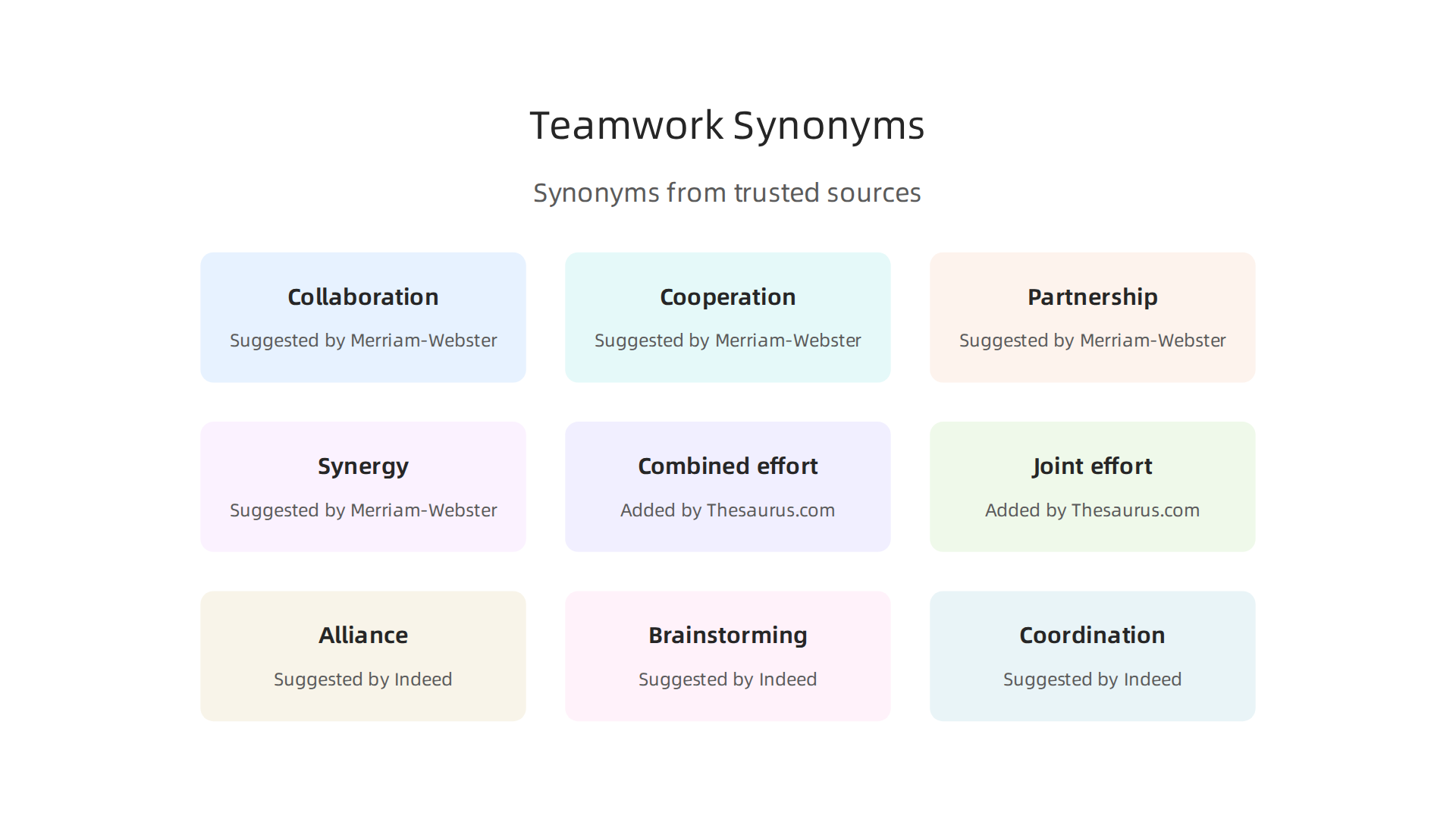
The same idea applies to the word "teamwork" itself. According to Merriam-Webster, common synonyms for teamwork include collaboration, cooperation, partnership, and synergy. Thesaurus.com adds terms like "combined effort" and "joint effort." And if you are updating your resume, Indeed suggests using words like alliance, brainstorming, and coordination to show you can work well with others without repeating yourself.
But why does this matter so much? Here is the thing. The language you use sets the tone before the activity even begins. When you call something a "creativity sprint" instead of "team building," people come in curious instead of bored. They know what to expect. Each synonym sends a different signal about purpose. Are you building team spirit? Focus on bonding language like "camaraderie session." Are you sharpening transferable skills? Try "skill-building workshop." The right words help participants understand the value right away.
Leaders who use precise language also see higher buy-in. Team members feel respected when the activity matches the label. They know their time is being used well. And that builds real organizational skills over time because people learn to work together in focused ways.
If you want to see how different activities line up with specific goals, check out this list of 10 little games for team building that build real connection. It is a great place to match your new vocabulary with actual exercises.
Ready to put your new words into action? Explore Activities that match exactly what your team needs right now.
The Core Concepts That Drive Every Team Building Activity
Now that you have a toolbox full of team building synonyms, you need to know when to use each one. The secret is understanding the core concepts behind every great team activity. When you know what your team really needs, picking the right words and the right exercise becomes simple.
Let me break it down for you. Almost every team activity focuses on one or more of these core ideas.
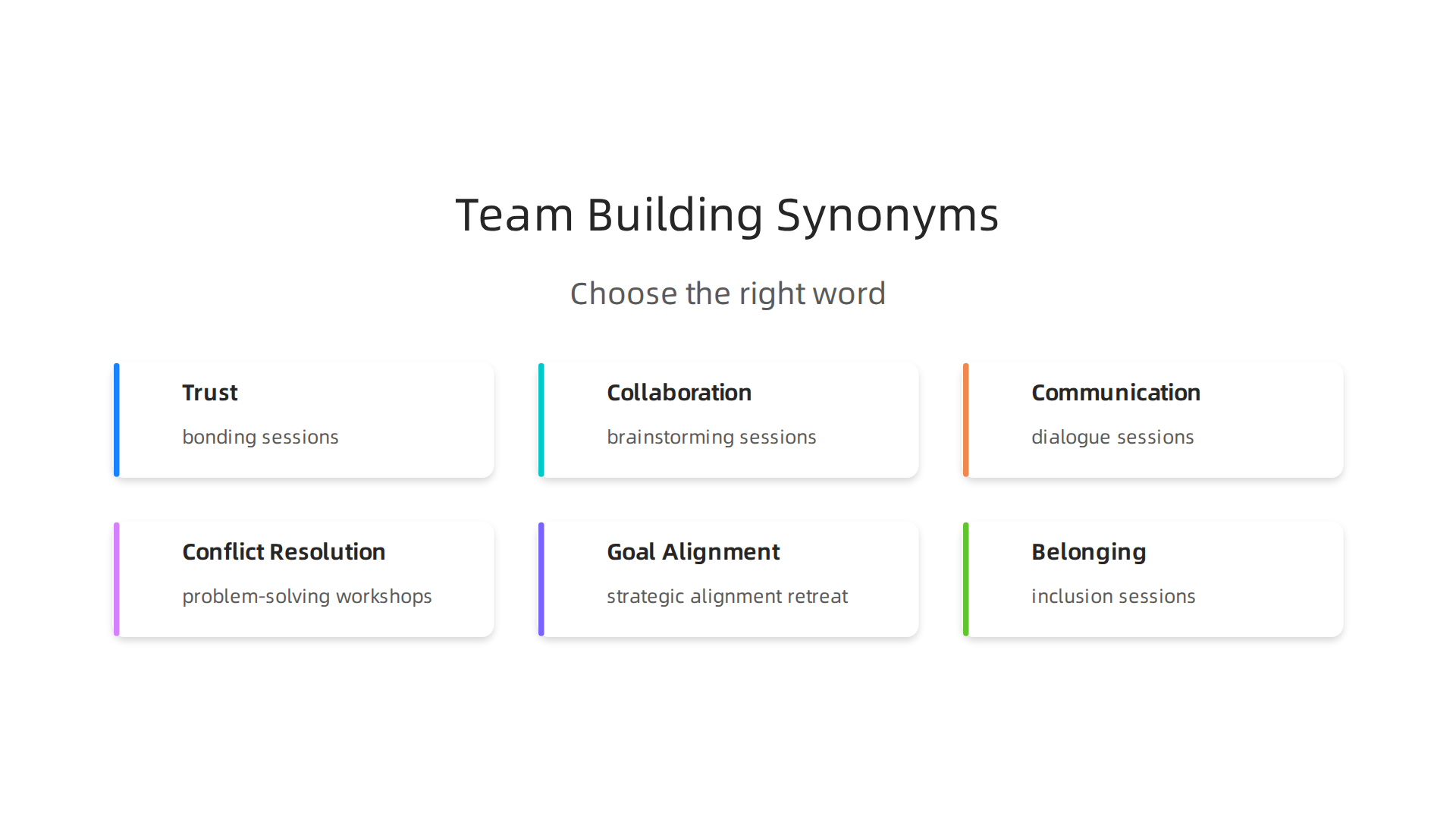
| Core Concept | What It Means | Best Synonym to Use |
|---|---|---|
| Communication | Sharing ideas clearly and openly | Communication workshop, dialogue session |
| Trust | Feeling safe to be vulnerable with each other | Trust exercises, bonding session |
| Collaboration | Working together smoothly on shared tasks | Collaboration sprint, coordination drill |
| Conflict Resolution | Handling disagreements in a healthy way | Problem-solving workshop, mediation session |
| Goal Alignment | Making sure everyone heads in the same direction | Strategic alignment retreat, goal-setting workshop |
| Belonging | Feeling included and valued by the group | Inclusion session, team cohesion activity |
Let’s look at each one more closely so you can see why it matters.
Communication is the foundation. High-performance teams rely on it. As one guide for 2026 puts it, effective communication helps members stay aligned and understand each other’s expectations [intangiblestalent.com].
Trust takes time to build but can be broken in seconds. According to MyCulture.ai, teams that focus on psychological safety and trust outperform others
[myculture.ai]. If your team needs to open up, a "trust exercise" is the right term.
Collaboration is about action. It is the ability to work as one unit. CoddyGames highlights collaboration as a key pillar of team building [coddygames.com]. A "collaboration workshop" signals that you will be working together on real problems.
Conflict Resolution is a skill every team needs. Calling it a "problem-solving session" makes the activity feel constructive and helpful.
Goal Alignment keeps the team focused. UC Berkeley recommends talking about progress toward goals [hr.berkeley.edu]. A "goal-setting workshop" does exactly that.
Belonging and Psychological Safety are the hot topics in 2026. Why? Because teams that feel safe share more ideas and take smart risks. If this is your focus, look for "inclusion activities" or "team bonding" exercises. Finding the right activity is easy when you know your goal. For example, this collection of 10 little games for team building that build real connection is great for boosting belonging.
Putting It All Together
When you match your team building synonyms to a core concept, your team understands the purpose immediately. They know their time is being spent on something valuable.
Want to start small and build a daily habit of connection? The Minute with Maxwell teamwork ritual is a fantastic way to strengthen organizational skills and team spirit without a huge time commitment.
Ready to find the perfect activity for your team’s biggest need? Explore Activities that target communication, trust, collaboration, and more. Let’s build something great together.
Top Team Building Synonyms by Core Concept
Have you ever said you wanted more "teamwork" but your team just nodded without really knowing what that meant? That is why grouping your team building synonyms by core concept is so powerful.
When you pick a synonym that matches a specific need, your team understands the goal from the start. Here is how to choose the right word for the right situation.
Trust
If your team struggles to be open with each other, you need "trust exercises" or "bonding sessions." These words tell people they will be vulnerable together in a safe way. For teams that are wary of physical contact (like trust falls), use "trust fall alternatives." That small change removes anxiety. Merriam-Webster lists "coordination" and "cooperation" as close synonyms for teamwork [merriam-webster.com]. Both fit here.
Collaboration
When the goal is working together on a shared task, use "collaboration sprint" or "brainstorming sessions." These words signal action, not talking. Indeed recommends "brainstorming" and "combined effort" as resume-friendly teamwork synonyms [indeed.com]. For creative teams, "brainstorming sessions" are perfect.
Communication
Teams that talk past each other need "communication workshops" or "dialogue sessions." These terms set a clear expectation: we will practice listening and sharing ideas. Business jargon like "dialogue session" can actually help frame the activity as professional and valuable [hookagency.com].
Conflict Resolution
Disagreements happen. Frame them as "problem-solving workshops" or "mediation sessions." This sounds constructive, not punishing. Thesaurus.com offers "combined effort" and "pulling together" as helpful alternatives [thesaurus.com].
Goal Alignment
If your team feels scattered, use "strategic alignment retreat" or "goal-setting workshop." These words signal clarity and focus. They tell people they will leave with a shared direction.
Belonging
This is the big one in 2026. Use "inclusion sessions" or "team cohesion activities." These terms show you care about psychological safety. For a quick way to build belonging, try these 10 little games for team building that build real connection.
Industry Specific Variations
Different teams speak different languages. Here are some tailored team building synonyms:
- Tech teams: Use "code retreat" or "scrum session." The term "scrum" is already used as a buzzword for self-organized teams [upwardenterprises.com]. Your team will connect instantly.
- Creative teams: Use "design sprint" or "brainstorm session." These words fit naturally in a creative workflow.
- Sales teams: Use "training alliance" or "partnership meeting." These terms feel productive and business focused.
The trick is simple. Match the word to the work. When you use "alignment retreat" instead of "team building," your team knows exactly what they are in for. They feel respected because you used language that fits their world.
For a daily habit that boosts team spirit and organizational skills, try the Minute with Maxwell teamwork ritual. It is a small start that makes a big difference.
Ready to find the right activity for your specific goal? Explore Activities that target trust, collaboration, communication, and more.
How to Match Synonyms to Your Team’s Specific Challenges
Knowing which synonym to use is half the battle. The other half is knowing exactly what your team needs right now.
Here is the thing. Many leaders jump straight to an activity without checking what is really going on. They pick "team bonding" when what the team really needs is "goal alignment." That mismatch leads to eye rolls and low energy.
In 2026, you cannot afford to waste time on the wrong activity. You need to diagnose first. Then match your language to the problem.
A Simple Diagnostic Framework
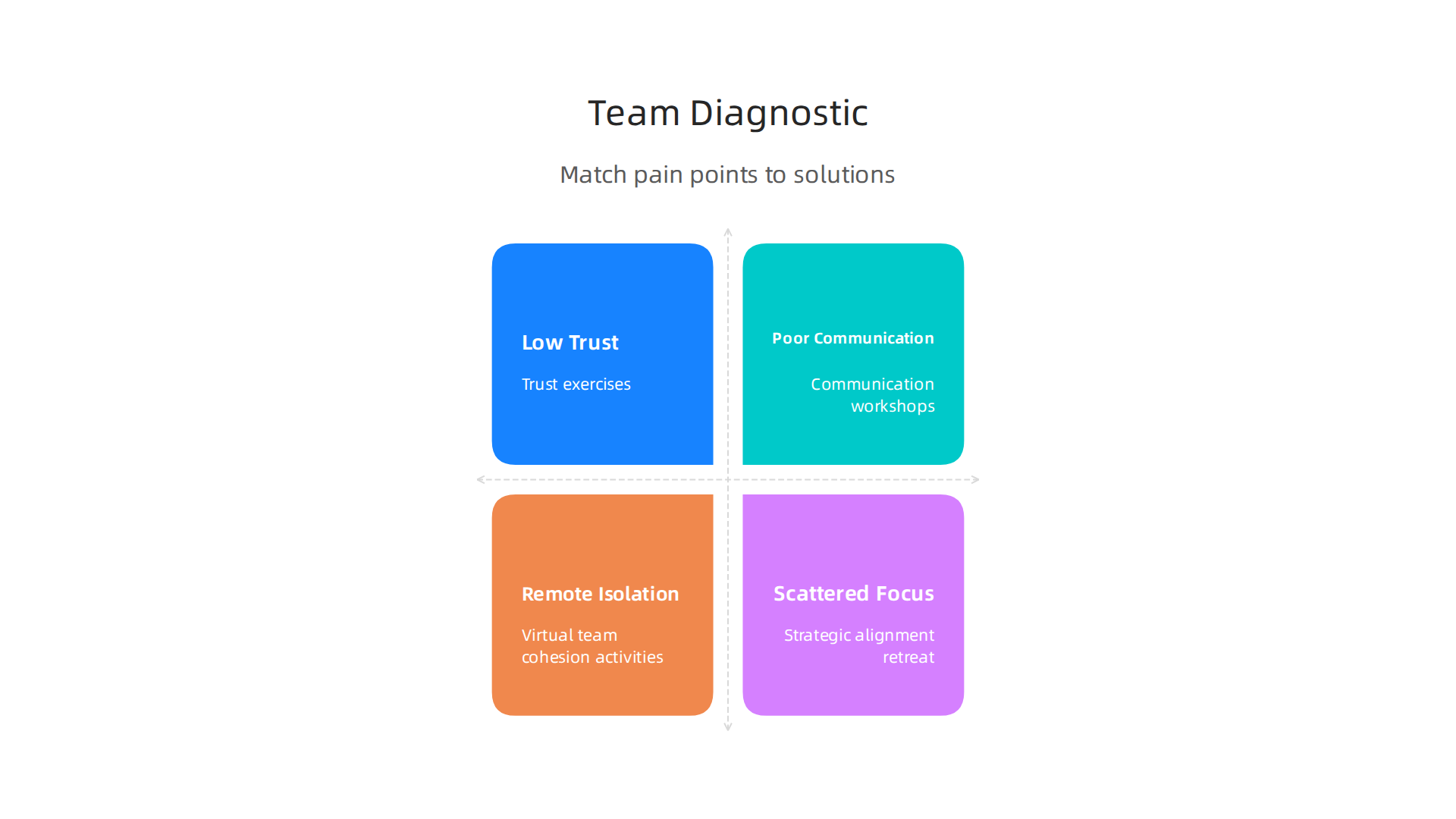
Start by looking at the signs your team is showing. Each pain point calls for a different team building synonym.
-
Pain Point: Low Trust. Do people hold back honest feedback? Do they cover up mistakes? Do they avoid being vulnerable? If yes, your team needs psychological safety. Use "trust exercises" or "bonding sessions." Psychological safety is one of the core characteristics of effective teams [myculture.ai].
-
Pain Point: Poor Communication. Are projects getting stuck because no one knows what anyone else is doing? Do emails get lost? Use "communication workshops" or "dialogue sessions." These words set a clear goal for the team.
-
Pain Point: Remote Isolation. Does your remote team feel disconnected? Is energy low on video calls? This is a huge challenge in 2026 [bridgeapp.ai].
Use "virtual team cohesion activities" or "inclusion sessions." These terms show you care about belonging.
- Pain Point: Scattered Focus. Is everyone busy but not moving toward the same goal? Use "strategic alignment retreat" or "goal setting workshop." These words signal clarity and shared direction.
Once you spot the pattern, you can pick the right word. Matching the language to the specific challenge shows your team you understand their real struggle. And when they feel understood, they engage more.
Why This Works
The right name frames the value. When you call it a "mediation session" instead of a "team building game," your team knows this is about solving a real problem. They respect the effort.
This diagnostic skill is a powerful transferable skill for any leader. It also sharpens your own organizational skills. You learn to assess, match, and act with purpose.
If you want to go deeper, try mapping out your team’s hidden friction points. This simple diagnostic guide will help you see the invisible dynamics holding your team back.
Once you know the diagnosis, you need a quick win. A simple, low-prep activity can make a real difference. Try these 10 low prep group games for adults that build real team connection as a starting point.
Ready to match the right activity to your team’s specific challenge? Explore Activities designed for every pain point.
Virtual and Hybrid Team Building: Essential Synonyms and Strategies
In 2026, a huge number of teams are remote or hybrid. That changes everything about how you talk about team building. If your team never meets in person, using a term like "retreat" feels out of touch. You need synonyms that fit the virtual reality. Words like "virtual bonding" or "digital collaboration" land much better. They tell your team you understand their actual work setup [bridgeapp.ai/resources/blog/remote-team-challenges-in-2026-how-to-solve-them].
But naming is only the first step. You also have to plan for how the activity happens. Some activities work best live, during a video call (synchronous). Think online trivia contests or digital escape rooms. These create real-time energy and team spirit [scavify.com/team-building/corporate-team-building][naboo.app/en-us/blog/30-team-building-activities-boost-morale]. Other activities work better when people do them on their own time (asynchronous). Virtual volunteering, shared reading, or a lunch club let people participate when it suits them [teamland.com/post/fun-virtual-activities-for-your-team]. That flexibility is key for teams spread across time zones. It also sharpens your own organizational skills because you have to balance both formats.
Hybrid teams are the trickiest of all. You have some people in a room and others on a screen. The wrong synonym can make remote members feel like second-class participants. Use phrases like "inclusive team gathering" or "unified collaboration session." These words set the expectation that everyone matters equally. Some companies rotate in-person events with virtual options so no one misses out too often [naboo.app/en-us/blog/30-team-building-activities-boost-morale]. Another strategy is to run an activity that both groups can do together, like an app-based puzzle competition where remote and in-person players race side by side [handstandwith.us/blog/best-virtual-team-building-activities-for-remote-teams].
This whole process is a powerful transferable skill. When you can match the right synonym and format to your team’s reality, you build trust and connection. You also show that you care about team work in every context. If you want specific, tested activities that work for remote, hybrid, and in-person teams, you can explore the full library of ideas. Many of them need very little prep and adapt easily to any setting.
Measuring the ROI of Team Building: Metrics That Matter
Here is the hard truth: in 2026, only about 31% of U.S. employees are actively engaged at work, according to Gallup data cited by Paycor [paycor.com/resource-center/articles/employee-engagement-statistics/]. That means most leaders need to prove their team building efforts actually work. The good news is you can measure the return on investment (ROI) for team building. You just need the right metrics.
Start with quantitative data. These are the hard numbers. Look at engagement surveys given before and after an activity. Track turnover rates over six months. Watch productivity scores like project completion rates or sales figures [sherlocked.nl/blog/how-investing-in-your-team-boosts-business-success]. Some companies also measure retention directly. Industry data shows 52% of HR departments report improved retention after introducing structured team building activities [papers.ssrn.com/sol3/Delivery.cfm/6632200.pdf?abstractid=6632200&mirid=1].
But numbers only tell part of the story. You also need qualitative metrics. This means team feedback from open-ended survey questions. It means observing actual behavioral changes in meetings. Do people communicate better? Do they show more team spirit? Effective ROI measurement focuses on observable behavioral change and business outcomes, not just activity metrics [teambuildingasia.com/blog/team-building-roi-2026-measurable-impact].
Here is where the synonym strategy from earlier comes back into play. If you run a "team bonding session" and measure improved "collaboration" scores, you can directly link the language to the outcome. Using terms like "team work" or "team spirit" in your goals makes it easier to define what success looks like. It also strengthens your business case to leadership.
To get reliable data, use surveys before and after activities. Set SMART goals. For example, "increase team work satisfaction scores by 10% within three months" [wellhub.com/en-us/blog/organizational-development/measuring-team-building-impact/].
Then track the numbers. This shows your organizational skills in action and turns a fuzzy concept like team building into a clear, measurable investment.
If you want to learn more about diagnosing team dynamics before you measure results, check out our guide on how to diagnose and reshape team roles and dynamics [activitiesthatbuildteamwork.com/how-to-diagnose-and-reshape-team-roles-and-dynamics]. It helps you know what to measure in the first place.
Ready to start measuring your team’s growth? Explore our collection of curated activities [activitiesthatbuildteamwork.com/blog] to find the right fit for your team.
Expert Recommendations for Selecting the Right Activity
Now that you know how to measure success, the next big question is which activity to pick. The wrong choice can waste time and money. The right one can transform your team. So how do you choose wisely?
Experts agree on one thing. You must start with a clear goal. Do not pick an activity just because it sounds fun. The first mistake most people make is choosing the activity before defining the objective [autreman.com/en/actualite-autreman/activites-de-team-building-conseils-et-tendances-2026/]. Think about what you want to improve. Is it communication? Trust? Problem solving?
This is where your team building synonyms become a powerful tool. If your goal is to improve "team work," choose an activity that requires collaboration, like an escape room challenge or a volunteer day [uplyrn.com/post-details/team-building-activities-for-work]. If you want to build "team spirit," pick something social and light, like a cooking class or a trivia game. Matching the synonym to the outcome gives you a clear focus.
Next, involve your team in the choice. When people have a say in the activity, they feel more ownership. They show up ready to participate instead of rolling their eyes. You can even share a few options and let them vote. This simple step boosts engagement before the event even starts [bestcorporateevents.com/team-building-expert-guide].
Finally, avoid overused activities that feel forced. A tired trust fall exercise rarely works in 2026. Instead, opt for tailored, context-aware options. Think about your team’s personality. Do they like competition? Try a fast-paced game. Do they prefer calm connection? A nature walk and reflection might be better [bamboohr.com/blog/team-building-activities-mega-list].
Need some fresh ideas that build real connection? Check out these low-prep group games for adults. They are simple, effective, and easy to run.
Your organizational skills shine when you plan a session that matches your team’s actual needs. Pick the activity with purpose. Your team will feel the difference.
Ready to find the perfect activity for your group? Explore our curated collection [activitiesthatbuildteamwork.com/blog] for tailored session ideas and guidance.
Summary
This article explains why the words you use for