How to Build a High-Performance Design and Engineering Practice Through Collaboration

Introduction
Imagine building something amazing, like a new app or a cool gadget. You need smart people to work together, right? That’s what good design and engineering practice is all about. When everyone on the team shares ideas and helps each other, great things happen.

But sometimes, teams get stuck working alone, like in separate rooms. We call these "silos," and they can make projects much harder and even cause problems.
Here in 2026, we know that teamwork is the secret sauce for innovation. This article is here to help you fix common team challenges. We’ll give you simple ideas and fun activities that help people work better together. You’ll learn how to build stronger bonds, improve communication, and even help reshape team roles and dynamics for the better. These tips are for everyone: managers, HR folks, startup founders, teachers, and especially leaders of remote teams. Whether you’re looking for organizational skills examples to share or want to make your scrum jobs more effective, you’ll find practical advice here. We’ll show you how a clear team charter can guide everyone, making collaboration a joy.
Ready to make your team shine? You might be surprised how much simple, low-prep group games can help build real connection and trust. Want to find more ways to boost your team’s spirit? Explore Activities
The Critical Role of Collaboration in Design and Engineering Practice
So why does collaboration matter so much for your design and engineering teams? Let’s look at the numbers. In 2026, industry research tells us that projects with strong collaboration simply perform better. One study found a clear link between how well teams work together and the overall success of their projects Research from ASCE. Another analysis of over 240 engineering design projects showed that good communication directly helped projects finish on time and on budget PMI research.

Here’s a bigger picture. A survey in 2026 found that 86% of people believe poor collaboration or bad communication causes workplace failures Data from HireBorderless. That is a huge number. Think about it. When your designers and engineers work in silos, mistakes happen. Important details get missed. The final product might not meet user needs.
But when you build a strong design and engineering practice around teamwork, everything changes. Teams report fewer errors. They bring products to market faster. And people actually enjoy their jobs more
Figma 2026 design statistics. The complex systems we build today need input from many different people. A single person cannot know everything. That is why cross-functional collaboration is non-negotiable.
The good news is that you can fix these problems. You can start by reshaping how your team works together. I have found that a clear team charter helps everyone understand their role. It also helps with things like scrum jobs and organizational skills examples. When everyone knows the rules and goals, collaboration becomes much easier. For a deeper look at fixing team problems, check out my guide on how to diagnose and reshape team roles and dynamics.
So take a close look at your team. Are people sharing ideas freely? Or are they stuck in their own little rooms? The answer will tell you a lot about your project’s chances of success. To find practical ways to start building better collaboration, browse curated activities that can help your team connect and work better together.
Top Barriers to Teamwork in Technical Workflows (and How to Overcome Them)
You already know that good teamwork matters. But what keeps getting in the way? In my work with teams, I see the same three problems come up again and again.
Communication breakdowns
This one tops the list. Language barriers alone cause real trouble for technical teams. They lead to miscommunication, technical errors, and less collaboration overall Preply research on engineering teams. Different communication styles and information overload add to the mess Worklenz analysis of workplace communication. One report lists using the wrong channels and outdated goals as top problems Axios HQ on internal communication barriers.
Siloed expertise and conflicting priorities
When designers and engineers stay in their own bubbles, they miss important context. A designer focuses on user experience while an engineer worries about system limits. Without a shared design and engineering practice, these priorities clash. That is where a team charter comes in. It sets clear rules and goals so everyone pulls in the same direction.
Remote and hybrid challenges
For distributed teams, the barriers get worse. You lose body language and quick check-ins. Meegle points out that miscommunication, lack of engagement, and tech problems are major hurdles for hybrid teams Meegle on hybrid team challenges. Poor audio and missing visual cues make things even harder Rcademy on virtual work barriers.
Simple fixes that work
The good news? You can fix all of these without spending a lot of money.
- Regular cross-functional syncs. Get designers, engineers, and product people in the same meeting every week. Talk about what everyone is working on.
- Shared documentation. Keep design specs, technical notes, and project updates in one place that everyone can see.
- Define scrum jobs clearly. When team members know their roles in the agile process, there is less confusion.
- Use organizational skills examples to set expectations. Show people what good planning and communication look like in practice.
The words you use to describe your work also matter. Reframing how your team talks about collaboration can shift the whole dynamic learn how to reframe your sessions.
For ready-to-use activities that tackle these barriers head on, browse curated team exercises that help your team communicate and collaborate better starting today.
Core Principles for High‑Performance Design and Engineering Collaboration
Once you clear the common barriers, the next step is building a foundation that keeps your team strong. In my experience, high-performing teams don’t happen by accident. They run on three core principles that make everything else easier.
Principle 1: Psychological safety
This is the big one. Team members need to feel safe enough to share rough ideas, admit mistakes, and ask dumb questions without fear. When psychological safety is low, people stay quiet. And when people stay quiet, your design and engineering practice suffers. You miss the early warning signs that could have saved weeks of rework.
A great way to build this safety is through regular team rituals. Check out this guide on using team rituals to create space for honest check-ins and retrospections.
Principle 2: Clear ownership
Everyone needs to know who owns what. Without clear ownership, tasks fall through the cracks. Define your scrum jobs explicitly so each person knows their role in the sprint. Use a team charter to document responsibilities and decision-making authority. When designers know they own the user research and engineers know they own the technical architecture, you avoid stepping on each other’s toes.
Principle 3: Iterative feedback loops
Feedback should happen early and often, not just at the end.

The Agile principles that guide software development in 2026 emphasize continuous improvement through short feedback cycles. You do not need a perfect design before showing an engineer. And engineers should not wait until code review to ask for design input.
This is where structured frameworks help. Design Thinking and Agile complement each other really well. Design Thinking helps you focus on user needs first. Agile gives you the rhythm to test and adjust quickly combining Design Thinking and Agile for software engineering. Together, they create a shared language for your design and engineering practice.
Agile design, as Atlassian explains, emphasizes collaborative, iterative development that involves designers, developers, and product owners together.

Early feedback and shared guidelines keep everyone moving in the same direction.
Aligning on shared goals
Misunderstandings often come from different definitions of success. Get your team on the same page by:
- Setting clear organizational skills examples that show what good collaboration looks like
- Defining project goals as a team, not in silos
- Agreeing on communication norms upfront (Slack for quick questions, meetings for decisions)
If you want to dig deeper into how roles and dynamics shape your team, this guide on diagnosing and reshaping team roles and dynamics offers practical steps.
Start your transformation today
These principles are not abstract ideas. They are practical tools you can use starting tomorrow. Pick one principle, try it with your team, and see what changes.
For more ready-to-use activities that put these principles into practice, explore the full collection of team exercises and find the ones that fit your team best.
Proven Team‑Building Activities for Design and Engineering Teams
Knowing the principles is one thing. Putting them into practice is where the magic happens. The best teams I’ve worked with don’t just talk about psychological safety or iterative feedback loops. They embed them into specific, repeatable activities that build muscle memory over time.
Let me share a few proven exercises that strengthen your design and engineering practice directly.
Design Sprint
A design sprint compresses the entire design thinking process into a few days. Your team defines a problem, sketches solutions, builds a prototype, and tests it with real users. This activity forces designers and engineers to work side by side from the start. You surface assumptions early and avoid costly build‑and‑rework cycles. It works great for kicking off a new feature or tackling a stubborn user issue.
Pair Programming
Pair programming isn’t just for engineers. When a designer sits alongside a developer, they both learn how the other thinks. The designer sees technical constraints up close. The engineer hears user rationale directly. This simple swap builds empathy fast. Even a one‑hour session once a week can shift how your team communicates. Many remote teams find collaborative coding challenges to be cost‑effective and engaging.
Prototype Jam
A prototype jam is a low‑stakes, timed challenge. Give your team a user scenario and one hour to build a clickable prototype. No polish, no perfection. Just rapid iteration and shared laughter. This exercise normalizes “good enough” early feedback and kills the perfectionism that slows down your design and engineering practice. It also reveals hidden strengths in team members you might not see day to day.
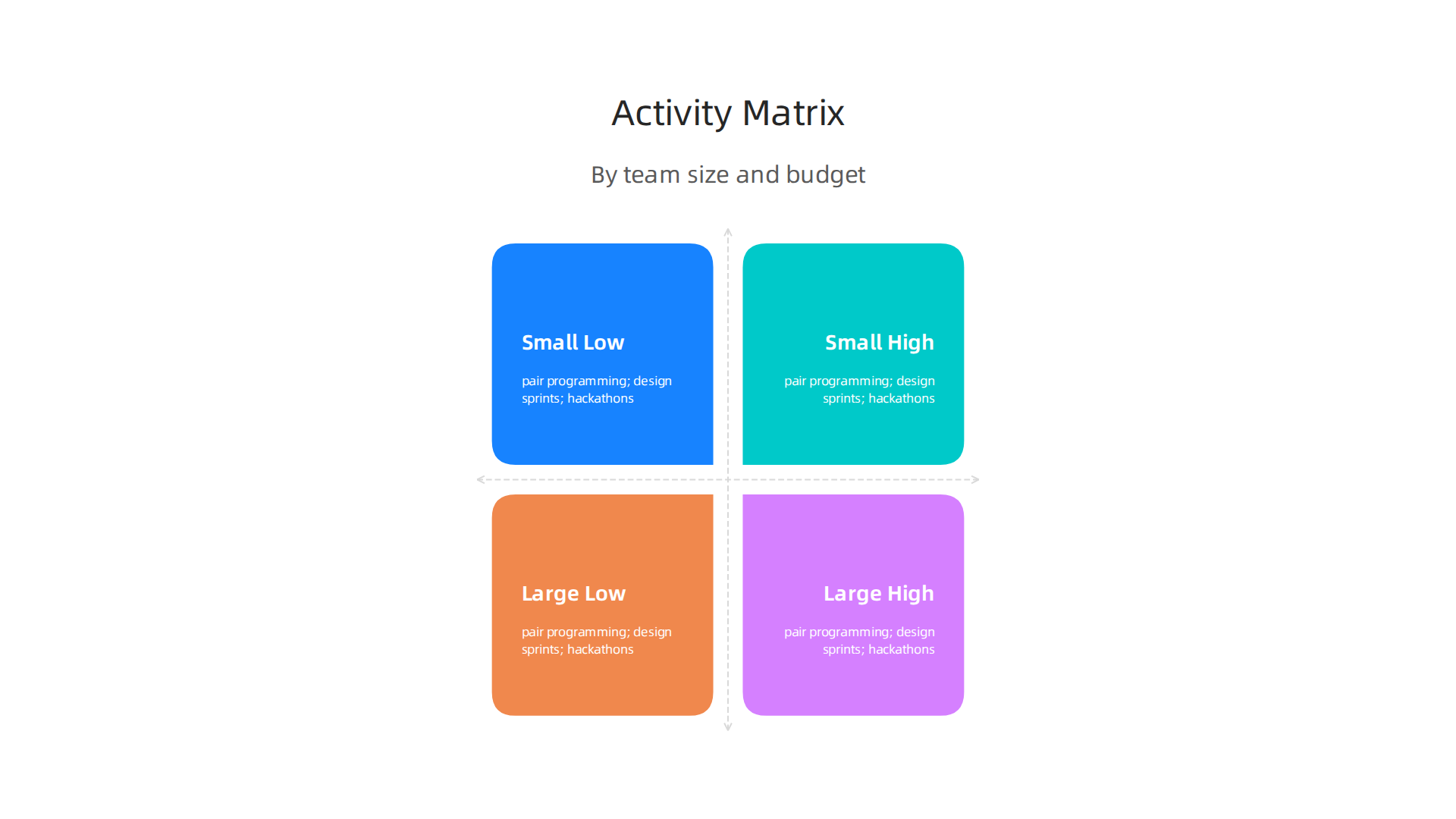
Match the Activity to Your Team
Not every activity fits every team. Here’s a quick guide:
| Team Size | Budget | Best Activities |
|———–|——–|—————–|
| 2‑5 people | Low | Pair programming, two‑person design critique |
| 6‑15 people | Medium | Design sprint, prototype jam |
| 16+ people | Higher | Hackathon, cross‑team showcase |
Even teams with tight budgets can find affordable options under $1000 that still deliver strong results. The key is picking an activity that solves a real friction point your team faces today.
The Shortest Activities Can Have the Biggest Impact
You do not need a full day off‑site. A 30‑minute “retro + sketch” session after each sprint can improve cohesion more than an expensive corporate event. The consistency matters more than the scale. Try weaving a short ritual like this into your existing cadence. It’s one of the best ways to implement a team charter without adding extra meetings.
Ready to Try an Activity Right Now?
Pick one exercise from this list and schedule it for next week. Don’t overthink it. Just run it and see what happens. For more ready‑to‑use games and exercises that build real connection across design and engineering, explore our full library of team‑building activities. You will find options for every size, budget, and outcome.
Tailoring Collaboration Activities for Remote and Hybrid Engineering Teams
The shift to remote and hybrid work has changed how design and engineering teams connect. You cannot just grab a whiteboard and gather around a table anymore. Without the right approach, communication gaps grow fast. Misunderstandings, information overload, and a lack of visual cues can slow down your whole design and engineering practice. Studies show that hybrid teams often face misalignment and lower engagement when processes are not adapted for virtual settings Meegle. But with a few intentional tweaks, you can build the same level of trust and collaboration as an in‑person team.
Activities That Work Well for Remote Teams
Some exercises translate directly to a virtual environment. Here are a few that top remote teams use in 2026:
- Virtual whiteboard sessions. Tools like Miro or FigJam let designers and engineers sketch, map user flows, and critique together in real time.

This works especially well for prototype jams or design sprints mentioned earlier.
- Async stand‑ups. Instead of a daily video call, use a shared document or a tool like Slack to post updates. This respects different time zones and gives everyone time to think. It is one of the simplest ways to keep your team charter alive across hours or continents.
- Paired debugging. A designer joins a developer for a focused bug‑fix session over video. The developer shares their screen, talks through the technical issue, and the designer asks clarifying questions. It builds empathy fast and prevents the “us vs. them” mindset.
Many teams also find success with structured virtual games and challenges. For example, collaborative coding challenges or online escape rooms can be both fun and effective Atlassian. If your group enjoys a shared laugh, a light‑hearted shared read like the Ridiculous comedy series can spark organic conversation without feeling forced. Check out Visit Ridiculous for a story your team can quote and talk about together.
Regular Rituals Bridge the Physical Gap
Remote teams need more deliberate check‑ins. Schedule consistent one‑on‑ones with each team member. They are your best tool for catching miscommunication early. Also, hold a team retrospective after every sprint. Use a shared board and invite everyone to post what worked, what didn’t, and what to try next. This keeps your organizational skills examples visible and actionable. Poor communication is one of the biggest causes of project delays Worklenz. A short weekly retro can prevent those issues from snowballing.
Ready to Try a Virtual Activity?
Start with one small change this week. Maybe an async stand‑up or a 30‑minute virtual whiteboard jam. The key is consistency over perfection. For more hands‑on ideas that work for any team size or setup, browse our library of team‑building games for real connection.
You will find activities designed for remote, hybrid, and in‑person teams alike. Explore Activities to find your next team ritual.
Measuring and Sustaining Collaboration: Metrics and Best Practices
You have set up virtual whiteboard sessions, async stand‑ups, and regular retros. But how do you know they are actually working? The best design and engineering practice relies on more than good intentions. You need to track what matters so you can keep improving.
Key Metrics That Show Real Collaboration
Start with a few simple numbers. Here are the ones top teams watch in 2026:
- Time‑to‑first‑feedback. How long does it take for a designer or developer to get a response on a shared mock‑up or pull request? Shorter time means tighter collaboration. Teams that give fast feedback catch issues early and waste fewer cycles.
- Cross‑team handoff frequency. Count how often work moves between designers, developers, and product owners. Frequent handoffs can signal strong alignment or, if too chaotic, a need to streamline. The goal is smooth, predictable transfers that keep everyone on the same team charter.
- Team satisfaction. A simple monthly survey asking “How well are we collaborating?” gives you a pulse. According to engineering KPI experts, team surveys are one of the best ways to gather feedback on team dynamics and collaboration effectiveness Jellyfish. When satisfaction dips, you can step in fast.
You also want quantitative measures like cycle time (how long a task takes from start to finish) and qualitative measures like open‑ended comments. Research shows that a mix of both gives you the clearest picture Figma. Poor collaboration is a top cause of workplace failures, with 86% of professionals blaming it for problems HireBorderless. Tracking these metrics helps you avoid that trap.
Sustain Gains with Continuous Improvement
Metrics alone do not fix anything. You need a rhythm. Hold a lightweight retrospective after every sprint or milestone. Ask the same three questions: What worked? What didn’t? What should we try next? This is a core Agile principle that keeps your organizational skills examples visible and your team always learning Monday.com.
Retros are also a great time to review your metrics. If time‑to‑first‑feedback is creeping up, ask why. Maybe you need to adjust your scrum jobs or clarify roles. The key is to treat these reviews as a habit, not a one‑time fix.
Ready to Measure and Improve?
Start with one metric this week. Track time‑to‑first‑feedback or send a quick team satisfaction survey. Then use the results in your next retro. Small, consistent steps build lasting collaboration. For more structured activities that keep your team aligned and engaged, browse our library of team‑building games for real connection. You will find exercises designed to support every step of your design and engineering practice. Explore Activities to find your next improvement tool.
Implementing Collaboration Practices on a Tight Budget: Affordable Strategies
What if your team needs better collaboration, but the budget for fancy tools and offsite retreats just isn’t there? You are not alone. Many teams face this same challenge. The good news is that a lot of the best collaboration practices cost almost nothing. You just need to know where to focus.
Free Practices That Deliver Real Results
Start with the people and processes you already have. Structured discussions, like daily stand-ups with a clear agenda, don’t cost a cent. Neither does peer feedback. Simple practices like “round robin feedback” after a design review give everyone a voice. According to a roundup of affordable team building ideas, many effective activities require little to no budget and can be run inside your regular meetings Group Dynamix. Another list of low cost ideas shows that even quick virtual icebreakers can build connection without spending money Avva Experience.
Free and Open-Source Tools
You don’t need an expensive subscription to collaborate well. Free tools like Miro’s basic tier (or open source alternatives like Excalidraw) let teams sketch ideas together. Slack huddles give you instant audio chats without extra paid features. For remote engineering teams, pair programming rotations and collaborative coding challenges are among the most cost-effective ways to build trust and share skills QuestWorks. If your team is fully remote, a simple weekly video call with a fun check in question can replace expensive virtual retreats Monday.com.
Leverage Internal Experts
Your team knows more than you think. Set up a lunch-and-learn where a designer shares tips on giving better feedback or a developer walks through a new tool. These sessions use existing talent and cost nothing beyond time. You can even rotate facilitators to build presentation skills. This approach fits perfectly with the idea of low prep group games that strengthen real connection without big budgets [link to internal article]. For engineering teams, activities like robot rallies or woodworking challenges can be organized with minimal materials Events In Minutes.
Start Small, Keep Going
Pick one free practice this week. Try a structured peer feedback session. Or test a free tool like Excalidraw in your next sprint review. Small steps build momentum. For more no cost and low cost ideas that you can run in any setting, browse our library of curated activities. Explore Activities to find your next team building win.
Summary
This article explains why strong collaboration is essential for modern design and engineering teams and offers practical steps to build it. It reviews the most common blockers—communication breakdowns, siloed expertise, and remote/hybrid friction—and gives low‑effort fixes like cross‑functional syncs, shared documentation, and clearer scrum roles. You’ll learn three core principles (psychological safety, clear ownership, iterative feedback) and how to turn them into repeatable rituals and activities such as design sprints, pair programming, and prototype jams. The guide also covers how to adapt exercises for remote teams, which metrics to track (time‑to‑first‑feedback, handoff frequency, team satisfaction), and how to sustain gains with regular retros. Finally, it emphasizes budget‑friendly approaches and free tools so teams can start improving collaboration immediately without big spend. After reading, you’ll know which concrete activity to try next week and how to measure whether it helped.